
Sabbat. The name is composed of three abbreviations: Tem. ohp.
Ab., *Templi omnium hominum pacis abhas*, "the father of the
temple of universal peace among men."
Some authorities hold that Baphomet was a monstrous head, others
that it was a demon in the form of a goat. An account of a
veritable Baphometic idol is as follows:
[describing the Levi Baphomet, perhaps Levi's descript. -- tn]
A pantheistic and magical figure of the Absolute.
The torch placed between two horns, represents
the equilibrating intelligence of the triad. The
goat's head, which is synthetic, and unites some
characteristics of the dog, bull, and ass,
represents the exclusive responsibility of matter
and the expiation of bodily sins in the body.
The hands are human, to exhibit the sanctity of
labor; they make the sign of esotericism above and
below, to impress mystery on initiates, and they
point at two lunar crescents, the upper being white
and the lower black, to explain the correspondences
of good and evil, mercy and justice. The lower part
of the body is veiled, portraying the mysteries of
universal generation, which is expressed solely by
the symbol of the caduceus. The belly of the goat
is scaled, and should be colored green, the semi-
circle above should be blue; the plumage, reaching
to the breast, should be of various hues. The goat
has female breasts, and thus its only characteristics
are those of maternity and toil, otherwise the signs
of redemption. On its forehead, between the horns
and beneath the torch, is the sign of the microcosm,
or the pentagram with one beam in the ascendant,
symbol of human intelligence, which, placed thus
below the torch, makes the flame of the latter an
image of divine revelation. This Pantheos should
be seated on a cube, and its footstool should be a
single ball, or a ball and a triangular stool."
In" of Sorcery and "(1851), Thomas Wright
stated:
Another charge in the accusation of the Templars
seems to have been to a great degree proved by the
deposition of witnesses; the idol or head which
they are said to have worshipped, but the real
character or meaning of which we are totally unable
to explain. Many Templars confessed to having seen
this idol, but as they described it differently,
we must suppose that it was not in all cases
represented under the same form. Some said it was
a frightful head, with long beard and sparkling
eyes; others said it was a man's skull; some
described it as having three faces; some sait it
was of wood, and others of metal; one witness
described it as a painting (*tabula picta*)
representing the image of a man (*imago hominis*)
and said that when it was shown to him, he was
ordered to 'adore Christ, his creator.' According
to another deposition, the idol had four feet, two
before and two behind; the one belonging to the
order at Paris, was said to be a silver head, with
two faces and beard. The novices of the order
told always to regard this idol as their saviour.
Deodatus Jaffet, a knight from the south of France,
who had been received at Pedenat, deposed that the
person who in his case performed the ceremonies of
reception, showed him a head or idol, which
appeared to have three faces, and said, 'You must
adore this as your saviour, and the saviour of the
order of the Temple' and htat he was made to worship
the idol, saying, 'Blessed be he who shall save my
soul.' Cettus Ragonis, a knight received at Rome
in a chamber of the palace of the Lateran, gave a
somewhat similar account. Many other witnesses
spoke of having seen these heads, which, however,
were, perhaps, not shown to everybody, for the
greatest number of those who spoke on this subject,
said that they had heard speak of the head, but that
they had never seen it themselves; and many of them
declared their disbelief in its existence. A friar
minor deposed in England that an English Templar
had assured him that in that country the order had
four principal idols, one at London, in the Sacristy
of the Temple, another at Bristelham, a third at
Brueria (Bruern in Lincolnshire), and a fourth
beyond the Humber.
Some of the knights from the south added another
circumstance in their confessions relating to this
head. A templar of Florence, declared that, in
the secret meetings of the chapters, one brother
said to the others, showing them the idol, 'Adore
this head. This head is your God and your Mahomet.'
Another, Gauserand de Montpesant, said that the idol
was made in the figure of Baffomet (*in figuram
Baffometi*); and another, Raymond Rubei, described
it as a wooden head, on which was painted the figure
of *Baphomet*, and he adds, 'that he worshipped it
kissing its feet, and exclaiming *Xalla*,' which he
describes as 'a word of the Saracens' (*verbum
Saracenorum*). This has been seized upon by some
as proof that the Templars had secretly embraced
Mahometanism, as *Baffomet* or *Baphomet* is
evidently a corruption of Mahomet; but it must not
be forgotten that the Christians of the West
constantly used the word Mahomet in the mere
signification of an idol, and that it was the desire
of those who conducted the persecution against the
Templars to show their intimate intercourse with
the Saracens. Others, especially Von Hammer, gave
a Greek derivation of the word, and assumed it as a
proof that gnosticism was the secret doctrine of the
temple....
Some occultists have suggested that the Baphomet of the Templars
was really the god of the witches deriving from the nature god
Pan. During the nineteenth century, the Austrian Orientalist
Baron Joseph von Hammer-Purghstall discovered an inscription on
a coffer in Burgundy which he claimed showed that Baphomet
derived from two Greek words meaning "Baptism of Metis" {Wisdom}";
the inscription exalted Metis or Baphomet as the true divinity.
When Karl Kellner and other early twentieth-century German
occultists founded the secret order".T.O. (Ordo Templi Orientis
or Order of Templars in the East), they installed the British
occultist Aleister "as head of the British section, and
gave he gave himself the magical name of Baphomet.
Encyclopedia of Occultism and Parapsychology, 2nd Ed.,
edited and revised by Leslie Shepard, Gale Research
Company, 1984; pp. 131-2.
"Bataille" and "Margiotta" claimed that the order of the Palladium
or Sovereign Council of Wisdom was constituted in France in 1737,
and this, they inferred, was one and the same as the legendary
Palladium of the Templars, better known by the name of "In 1801 one Isaac Long, a Jew, was said to have carried the
"original image" of Baphomet to Charleston in the United States,
and it is alleged that the lodge he founded then became the chief
in the Ancient and Accepted Scotch Rite. He was succeeded in due
course by Albert Pike, who, it was alleged, extended the Scotch
Rite, and shared the Anti-Catholic Masonic chieftainship with the
Italian patriot Mazzini. This new directory was established, it
was asserted, as the new Reformed Palladium Rite or the Reformed
Palladium.
Ibid, p. 330.
"
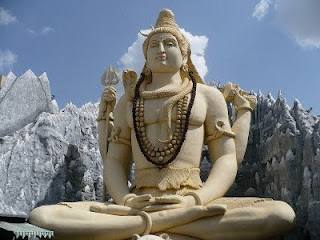
He can either be depicted in an abstract form via the shiva lingam, a phallic symbol of the male creative energy, or in human form of a four-armed young man either deep in meditation or dancing the Cosmic Dance.
Perhaps the word "destroyer" is misleading, as destruction in this case leads to better things, clearing the way for the new, leaving by the wayside all that hinders and which is unhelpful or unhealthy. Much like the Death card in the Major Arcana of the Tarot, with death leading to rebirth.
His wife is Pavati (or Shakti), he is the father of Ganesha (remover of obstacles). He is indelibly linked with the Ganges River, when the Goddess Ganga fell to earth, he caught her in his hair, breaking her fall and allowing her to gentle trickle to the ground. He is often depicted with matted hair, piled on top of his head, pouring forth the waters of the Ganges.
One legend describes how Shiva travelled to the dense forests of South India, where there lived a large number of heretical sages. The sages argued amongst themselves, but eventually their ire became focussed upon Shiva. They conjured creatures to destroy him, firstly a tiger summoned from the sacrificial fires. Shiva simply hooked the fierce beast with his fingernail, skinned it and wrapped the hide around himself.
The sages tried again, this time their offerings brought forth a huge serpent. Shiva took the snake, and wrapped it around his neck, wearing it as a garland. Shiva began to dance.
The third and final attempt upon Shiva's life was to bring forth a monster in the form of malignant dwarf. Shiva pressed his foot against the dwarf and broke its back, leaving it prostrate and helpless upon the floor, and continued his dance.
Shiva Symbolism:
There are many symbols associated with Shiva, some of these are:-
Blue throat/skin - from a time when poison churned in the oceans, Shiva drank the poison and kept it in his throat, where it left a permanent stain.
Third Eye - representing wisdom and insight. This eye is often a source of a fierce cleansing fire, specifically focussing upon evil.
Cobra necklace and tiger skin - representing his mastery over the world's dangerous creatures (and evil), and also the power of destruction and recreation, as snakes are continually shedding their old and outgrown skins.
Trident - representing his powers of will, action and knowledge.
White Bull - the bull is his vehicle, and can represent power and ignorance, and in this context Shiva can be seen to exert his power and destroy ignorance.
Hour-glass drum - beating the rhythm of the universe, and of the dance.
Sources:
Wikipedia
religionfacts.com
bbc.co.uk
Picture from Wikipedia
Love and hugs
Blaidd
Notwithstanding these contentions, let us say that there is an axiom to the ancient astronaut theory. Then we need to ask, who were these beings? What did they represent to the inhabitants of earth? Where these beings the ancient Gods of antiquity?
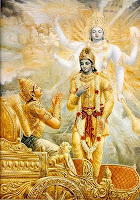
I would like to periodically chronicle my speculation of how the native people interpreted these unknown entities. This edition describes "Krishna, The Divine Source".
Krishna is usually regarded as an avatar of Vishnu and in some traditions considered the Supreme Being. Lord Krishna is the embodiment of love and divine joy, that destroys all pain and sin. He is the protector of sacred utterances and cows. Krishna is an instigator of all forms of knowledge and born to establish the religion of love.
Tradition holds that Krishna saw Vishnu in a vision in which the former deity told Krishna to destroy Kamsa son of a demon, a tyrannical ruler of the world. Krishna's mother, Devaki, was Kamsa's half-sister. Kamsa already killed her first six sons because he had been told one of her sons would kill him. Krishna' elder brother, Devaki's seventh child, Balarama was miraculously saved by Vishnu.
Krishna was also saved when exchanged by his parents for the daughter of a herdsman Nanda and his wife Yasoda (the daughter was also a divine being, an incarnation of Maya). With his foster parents Krishna spent a happy life playing boyish pranks and seducing the gopis (cow girls) and other rustic maidens. They found his flute playing irresistible. Legend has it he may have had 16,000 wives. But his favorite was Radha, daughter of his foster father, and his childhood lover, although they did not marry.
According to legend Krishna was not only divine, but heroic as well. He is alleged to have defeated numerous dragons and monsters, and eventually as predicted, killed his half-uncle the tyrannical king Kamsa.
It was said that demi-gods or devas use to appear frequently to people and gave them technology and knowledge, they also interbred with the population. The Rishis were the keepers of the highest science and knowledge and they learned this from a "divine source".
Some examples of mortal and gods interaction:
Kunti got all her sons from the gods. She learnt how to summon these gods from a Rishi who gave her a mantra for each god. Also, Kunti's fathers grand father was actually a naga (shape shifting serpent)
Krishna's city of Dwarika and Ravans city of Lanka was built by Vishwakarma, who was the chief architect and engineer of the demi-gods. Vishwakarma was also to transport entire land masses. He also revealed the art of mechanical engineering and architecture to humans. And made the weapon "Agneyastra".
The demi-god Indra was where Arjuna (who was his son) obtained all his celestial futuristic weapons and his vimana (aeroplane).
Krishna, was "not of this Earth" and he knew all the demi-gods very well and they all revered him. In fact Krishna was implanted into the womb of mother of Krishna by a ray of light from the sky (virgin birth).
The story of Krishna also narrates the tale of how Shalva attacked the city of Dwarka with what appears to be a flying saucer.
On learning of Shishupala's death, his friend, Salva, invoked Shiva and secured from him a flying saucer, a vimana that could travel anywhere in the world, in air, on the ground, under the sea. Using this vimana, Salva launched an attack on Dwaraka determined to avenge his friend's death. Both Krishna and Balarama were in Indraprastha attending Yudhishtira's coronation when this happened. So the defence of the city was left to the other Yadavas. Dwaraka was pounded by missiles from the skies. Krishna's sons and grandsons put up a brave fight but were no match for Salva. When news of the aerial attack on Dwaraka reached Krishna, he hurried home and entered the battlefield immediately. First he shot an arrow with the Sharanga bow and brought Salva's vimana down as if it was a bird. He then hurled the Kaumodaki mace and smashed the vimana to dust. Then raising the Nandaka sword, he beheaded Salva. The Yadavas were jubilant in victory.
Even the Ramayana talks about a flying chariot called pushpaka-vimana. To many the account of this chariot is not poetic imagination but historical evidence that airplanes existed in Vedic times. The chariot belonged to the yaksha-king Kubera. Ravana took it by force after driving Kubera out of Lanka. Ravana used the chariot to abduct Sita. After killing Ravana and rescuing Sita, Rama returned to the city of Ayodhya on this flying chariot.
Gandhari cursed Lord Krishna that he would perish after thirty-six years, all alone and in a miserable state. All his followers, devotees, relatives and loved ones will also die simultaneously. When this time arrived in Krishna`s life; a madness seized the inhabitants of Dwaraka in such an extent that the people started to kill one another. All sons and grandsons of Krishna were also dead in the massacre. Only the women, Krishna and Balaram were alive in Dwaraka.
After a while Balaram isolated himself in a dense forest. Lord Krishna then went to his father, took blessings and left for the forest, where Balaram awaited him. He saw that his elder brother was sitting under a mighty tree on the fringes of the forest. Balaram was sitting in a posture of a Yogi, eventually a thousand headed snake, `Ananta naga` came out from his mouth and glided its way to the ocean. Soon, the ocean and other holy rivers came together to welcome Anant Naga into their realm.
Lord Krishna saw his brother depart from the real world and he started to wander in the forest. Finally he sat on the ground, started to think of Gandhari`s curse, and realized that the time for his departure has already arrived. He self-possessed his senses and concentrated on his Yoga. A hunter approached that spot of the forest and from a distant saw him and thought to be a deer. He loosed his shaft, took out the arrow, and mistakenly pierced Lord Krishna`s foot. He came hurried near to the Lord and saw him to be a man wrapped in yellow robes practicing yoga. The hunter immediately touched the feet of Lord Krishna and asked for apology.
Lord Krishna opened his eyes and comforted the hunter, then ascended towards the heaven, thus filling the whole sky with glory. After passing through Indra`s paradise, he reached his place at even higher strata. Krishna wives; including Rukmini became Sati and burned themselves on pyre. The rest of the women of Dwaraka became ascetics and nuns. After each and every living being of Dwaraka moved away to other places, the ocean came about and engulfed the city, thus leaving no trace of the land of Lord Krishna.

I surrender to you, Lord Ganesha. You are the speaker. You are the listener. You are the giver. You are the sustainer. I am your disciple. Protect me from the front and back. Protect me from the north and the south, from above and below. Protect me from all directions.
You are full of perfect knowledge of truth and awareness. You are full of bliss and pure consciousness. You are truth, consciousness and bliss. You are the absolute awareness. You are full of supreme wisdom and knowledge.
You are the earth, water, fire, air and the space. You are the root foundation of speech. You are beyond the three "gunas": "sattva", "rajas", and "tamas". You are beyond the physical, mental, and causal bodies. You are beyond the three aspects of time: past, present, and future. You are eternally established in the "muladhara" chakra. You have three "shaktis": action, knowledge, and will.
Salutation to the "Ganapati "whose seed mantra is "Aum Gam." We know "Ekadanta", the One-tusked God, the unique God. We meditate upon "Vakratunda", the curved-trunk God. May that unique elephant God illumine our consciousness and direct us along the right track.
One should meditate upon Lord Ganesha having one tusk and four arms; holding the noose and goad with two of them; with the other two indicating "varada", the giving of boons and blessings, and "abhaya mudra", the fear removing gesture; having a mouse as the emblem on his ensign; possessing a big, beautiful belly and large, lovely ears which look like winnowing baskets; having a red cloth and His whole body covered with red sandalwood paste. He should be worshiped with red flowers. He manifests Himself as the universe and is beyond "pakriti", matter, and "Parusha", the manifest God. One who worships Ganesha in this way forever is the best of yogis.
Prostrations to "Vratapati", the Lord of Plenty. Prostrations to "Ganapati", the Lord of various groups of Gods. Prostrations to "Pramathapati", the Lord of Shiva's hosts. Prostrations to "Lambodara", the full-bellied God with a single tusk, destroyer of obstacles, the Son of Shiva, the Bestower of all Blessings.
He who chants this "Ganapati Upanishad" will verily get established in "Brahman", the pure awareness. He will never encounter any obstacles. He will be happy everywhere. He will be free from the five great sins and lesser ones. By reciting this in the evening, the day's sins are destroyed.
By reciting this in the early morning, one becomes free from the sins committed at night in dreams. Reciting this morning and evening, one becomes totally free from all sins. He becomes totally free from all obstacles. He achieves the four divine ends of life: "dharma", "artha", "kama", and "moksha"; virtue, wealth, pleasure, and liberation.
"AUM GANESHA SARANAM SARANAM GANESHA."
"
Exerpted from Ganapatyatharsirsham
translation by Dr. Vasant Lad

Ganesha is famous not only for being a trickster and for his sense of humour, but equally for his wisdom. He is the son of Shiva (Destroyer in the Hindu Holy Trinity of Creator-Preserver-Destroyer) and Parvati (Shiva's consort).
The chubby, gentle, wise, elephant-headed Ganesh, or Ganesha, is one of Hinduisms most popular deities. He is the remover of obstacles, the deity whom worshippers first acknowledge when they visit a temple. He is also patron of letters and of learning; he is the legendary scribe who, using his broken tusk, which he often holds, wrote down parts of the Mahabharata epic.
"from "Loving Ganesa"
by Satguru Sivaya Subramuniyaswami
Popular Posts
-
Astraea: Italian goddess of truth and justice. Also known as Astria. Aradia: Italian witch goddess. She came to earth to teach her mother ...
-
Tweet Svetovit is a supreme god. Among Western Slavs he was probably worshipped on equal terms with Perun and Svarog, but his warlike solar ...
-
"The goat idol of the "and the deity of the sorcerers' Sabbat. The name is composed of three abbreviations: Tem. ohp. Ab., *Te...
-
Tweet Taken from: Otto Freiher von Reinsberg-D"uringsfeld, " Aberglaube-Sitten-Feste Germanischer Volker, das festliche Jahr ...


