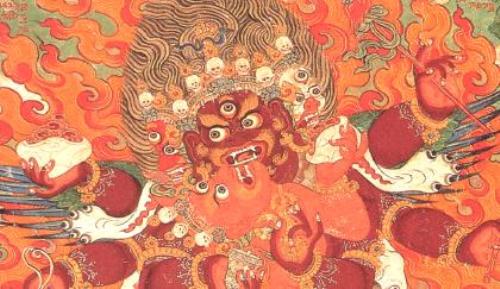
The wrathful deities are the powerful counterparts of the peaceful deities. Like demonic monsters we commonly see in films, they capture the spirit of the dead and try to drink its blood (which symbolize one's desires and passions) from cups made out of human skull. Because these visions are so intensely frightening, the consciousness of the dead person tries to get away from them, eventually descending into the lower realms of the after death state until it is propelled to its proper place for rebirth. More on the gory details later.
Another characteristic of the wrathful deities of the bardo is that of having animal heads with human bodies which is something particularly comparable to the gods of ancient Egypt such as Horus (falcon), Thoth (ibis), Anubis (jackal), Bastet (cat), Hathor (cow), Khnum (ram), and Serket (scorpion). Like the animal-headed deities from the Egyptian pantheon, the wrathful deities also have symbolic meanings which can be deciphered by studying what the corresponding animals represent.
Are the Wrathful Deities real?
What is their purpose?
As mentioned in the previous article, all the peaceful and wrathful deities are only archetypal images of the mind that have no reality of their own. They are empty and cannot harm the body of an enlightened awareness. All the blood-drinking and animal-headed deities of the bardo are mere projections of the intellect and they emerge from the four directions of the third eye chakra.
However, since it was mentioned that the consciousness of the dead person is already capable of having sensory awareness after it has gone through the first bardo, it experiences the vision of the wrathful deities in full realistic horror, even more unbearable and dreadful than The Exorcist, The Ring, or A Nightmare on Elm Street in 4D. Wait... 4D?
Now, the effect of the images becomes even stronger if the awareness-body tries to evade or reject them. This is not good news for the dead person because evading or rejecting these visions would cause its consciousness to descend into unconsciousness. This basically means that instead of having power over these entities by accepting them as aspects of your own consciousness, they gain power over you. Figuratively speaking, all the demons hide inside the subconscious and wield their influence in your life now because before you were born, your consciousness wasn't strong enough to overcome them in the after death state (assuming you accept rebirth as part of your belief system). It is, therefore, reasonably important for spiritual practitioners in Tibetan Buddhism and other traditions to pay attention to this fact during their lifetime and distinguish these hidden aspects of consciousness to avoid being overwhelmed once they leave this world.
According to the Tibetan Book of the Dead, all the wrathful deities appear in order to purify awareness of false thinking, ignorance, and delusion. Any kind of reaction that is the result of fear is a movement towards rebirth. If you are able to recognize the deities by name and see through them as mere illusions, they instantly lose their power over your consciousness and you achieve liberation.
The Vision of the Wrathful Deities
(12th to 19th DAY)
All the deities you will see here are the polar opposites of the peaceful deities. The wrathful deities appear on a lotus-sun throne of the forehead mandala (third eye chakra) and stand in a blazing aureole of flames. Since they are quite numerous, I can only provide a short description for each group of deities. If you are interested to know more about them, you can search their names on Google/Wikipedia or, even better, read the English translations of the Tibetan Book of the Dead. Also, it's quite hard to find pictures that exactly fit the descriptions I have, so forgive me if this creates a little bit of confusion.
1. THE POWERFUL MAHASRI-HERUKA
"
Mahasri-Heruka"
The visions start with Mahasri-Heruka, the lord of the "blood-drinking deities." He is the tremendously wrathful expression of Adibuddha (the source of all the buddhas and bodhisattvas in the bardo). Mahasri-Heruka is usually depicted as red-brown in color with three heads, nine eyes, six arms, and four legs surrounded by a ring of flames. His right face is the color of smoke, the middle is white, and the left is red. In his three right hands he carries a short metal weapon called vajra, a trident, and a drum with a handle. In his left hands he carries a bell, a skull cup, and a sling made from innards. The powerful Heruka is usually depicted in tantric union or "yab yum" with his dakini, whose color is pure white. Like the Adibuddha, the powerful Mahasri-Heruka occupies a special position among the bardo deities and all of the symbols associated with him have specific meanings.
2. THE FIVE BLOOD-DRINKING DEITIES
"
The Five Blood-Drinking Deities"
The next vision involves the Five Blood-Drinking deities (a.k.a. Buddha-Herukas) in tantric union with their five dakinis. Their purpose is to annihilate the five principal failings of human behavior (ignorance, hatred, pride, passion, and envy) while the five dakinis enlighten the five elemental realms (earth, water, fire, air, ether). All of them have three heads, six arms, and four legs and are adorned with crowns of skulls and skull-necklaces. They are usually depicted in paintings with wings of the garuda bird, a mythical bird that symbolizes the power to overcome evil.
1. BUDDHA-HERUKA - appears in the center with his smoky-white dakini Krodhesvari. This wrathful Heruka is an emanation of Buddha Vairocana, manifesting himself in a terrifying flaming form. In his right hands he carries a long-handled axe, a flaming sword, and the wheel of the teachings; in his left, a kapala, a ploughshare, and a bell.
2. VAJRA- HERUKA (dark blue ) - appears in the east with his dakini Vajra-Krodhesvari
3. RATNA-HERUKA (yellow) -appears in the south with his dakini Ratna-Krodhesvari
4. PADMA-HERUKA (red) - appears in the west his dakini Padma-Krodhesvari
5. KARMA-HERUKA (green) - appears in the north with his dakini Karma-KrodhesVari
Note: The descriptions do not match the picture.
3. THE EIGHT KEURIMA ">
The next vision involves the eight Keurima and the eight animal-headed Phramenma. All of these deities originate from the various regions of the head. They wear leopard-skins and hover in empty space, surrounded by blazing flames. They should not be feared, but instead be considered as mere projections of the mind. Psychologically, they have the same purpose as the Eight Mahabodhisattvas and their Dakinis.
The Keurima are the counterparts of the Eight Mahabodhisattvas from the mandala of the peaceful deities. Their sole purpose is to purify and enlighten the eight kinds of awareness (the psychic organs of perception). The Keurima are divided into two groups. The first group of dakinis is of the cardinal directions of the mandala and of pure colors. The other four are of the intermediate directions with mixed colors.
The Phramenma are the eight animal-headed deities who rule over the eight realms of consciousness (the corresponding physical organs of perception). They are the wrathful counterparts of the eight dakinis of the Eight Mahabodhisattvas. Four of the Phramenma have animal heads and they correspond to the four cardinal directions of the eight-petalled lotus. The other four have bird heads and correspond to the intermediate directions.
4. THE FOUR ANIMAL-HEADED FEMALE GUARDIANS OF THE MANDALA
The next vision involves the Four Animal-Headed Female Guardians. Their purpose is to indicate to the dead person its four boundaries. These boundaries represent the "Four Sublime States" (compassion, loving-kindness, sympathetic joy, and equanimity).
5. THE 28 ANIMAL-HEADED DEITIES
Finally, the awareness-body comes face to face with the rest of the crew, the 28 powerful Animal-headed Deities who are enjoying their sumptuous banquet of corpses, internal organs, and blood. Their purpose is to help consciousness to overcome any remaining false ideas and karmic hindrances so that it may be freed from all passions and attachments.
THE END OF THE CHONYID BARDO VISIONS
During the entire period of the Chonyid Bardo experience, the lama or guru keeps on reminding the consciousness of the dead person through the death ritual how important it is to recognize these images as one's own thought-forms even if he spent years of his life studying scriptures or practicing tantric techniques. Failure to do so at this point means failure to achieve liberation or moksha/buddhahood. Also, if one flees from the thought-forms out of fear all-throughout the visual experience of the wrathful deities, all of them will finally transform to the most powerful and terrifying aspect of the Lord of Death, Dharma-Raja, who represents ignorance, hate, and greed. The peaceful deities, on the other hand, turn into a powerful protective deity called Mahakala representing wisdom and enlightenment, although still wrathful in form.
"They will come having their upper teeth biting the nether lip; their eyes glassy; their hairs tied up on the top of the head; big-bellied, narrow-wasted; holding a karmic record-board in the hand; giving utterance from their mouth to sounds of 'Strike! Slay!', licking human brain, drinking blood, tearing heads from corpses, tearing out the hearts..."
Source: http://www.summum.us/mummification/tbotd/book1.shtml
Now you can just imagine how this can turn out to be such a bad day for the dead person without someone reminding him that it is not real. This is also why sacrifices and prayers are given as part of the death ritual just so the dead can make it through the dangers of the afterlife. From a psychological standpoint, these visions are seen as the processes of instinctual life, the repressed emotions, and the core patterns of memory and perception that are hidden from our consciousness. Carl Jung refers to this process, taking place in real life, as an encounter with the shadow. When this happens, the elements that occupy the unconscious mind try to penetrate consciousness and force the individual to face his own demons which are projected into the outside world. For Buddhists, the only way to overcome this in life, or even in death, is through the expansion of one's consciousness. In the next article, I will discuss the Sidpa Bardo wherein the journey through the six realms of existence and the search for the next place of rebirth take place. Say your prayers before going to bed, ayt?
Read all the articles in the Buddha Mind series.

You may be asking why the Hindus would use such a word as "death" to name the first set of practices in yoga. Well, according to Indian mythology, Yama is the god of death (the lord of the celestial abodes that one visits after one's life has ended). Other cultures have their own version of Yama, like Anubis (Egyptian mythology), Hades (Greek mythology), and Pluto (Roman mythology). However, in the consideration of yoga, what is being represented is not the death of the physical body, but instead, the death of one's identification with individual existence, which is referred to in psychology as the 'ego'.
WHY DO WE NEED TO PRACTICE YAMA?
All spiritual and religious traditions have guiding principles for engaging with others in society. These principles encourage ethical ways of living, but I do believe it goes far beyond that. If you contemplate on the concept about bringing death to the ego, you may also arrive with the following ideas:
* You live in a world inhabited by other beings who, just like you, need to evolve spiritually in their own unique way. Earth is our training ground and we need to give each other the chance to learn by making sure that this place we call reality is conducive for this goal. Wouldn't it be fun to live in a world without violence, dishonesty, theft, sexual misconduct, and greed - all crazy impulses that the helpless ego cannot control?
* The Ego is the organizing center of the mind. Most of the time, however, it doesn't do a good job in controlling your thoughts, especially when it is disturbed because of one's ignorance of moral values. This is why there is a need for you to establish a connection with your true self by doing yoga so that you can abandon your conceptions of being in control.
* The Ego creates a sense of attachment between consciousness and the physical body. In the advanced practices of yoga, practitioners are required to work with the subtle and causal bodies, so there's really a need to let go of one's ego. This stage is said to be wherein one may experience going out of one's body and even out of the the realm of mind. It's totally different from being insane, of course.
THE YAMAS (5 ABSTENTIONS)
1. AHIMSA (NON-VIOLENCE)
The first Yama called himsa means "violence." Ahimsa is the practice of non-violence (physical, mental, and emotional) towards other living beings and yourself. To the Hindus, violence or himsa can be of three types: krta (harming others directly), karita (harming others indirectly) and anumodita (supporting an act of violence).
2. SATYA (ABSENCE OF FALSEHOOD)
The second Yama called satya means "truthfulness or the absence of falsehood." Satya is the practice of speaking the truth at all times. People who faithfully practice the four other abstentions have no problem in telling the truth in everything they say. The ones who, for example, beat people up, fornicate, steal from others, and so on will undoubtedly have a hard time dealing with their conscience.
3. ASTEYA (NON-STEALING)
The third Yama called steya means "theft." Asteya is the practice of not stealing. Obviously, there is an increasing pressure on your mind when you take something which is not yours and keep it to yourself. Violate this code and you also violate three others: ahimsa, satya, and aparigraha.
4. BRAHMACHARYA (SEXUAL CONTINENCE)
The fourth Yama called brahmacharya is derived from the words brahman meaning "unity consciousness" and achara meaning "pathway." Bramacharya may have two meanings. In one sense, it means avoiding over-indulgence of the senses. Another meaning refers to abstinence particularly in terms of sexual activity.
5. APARIGRAHA (ABSENCE OF AVARICE)
The fifth Yama called aparigraha means "not being acquisitive." It is the avoidance of unnecessary attainment of things that are not essential to maintaining life. The logic behind this is pretty simple, really. Acquiring fame and fortune, for example, guarantees attachment to them. As your fame and fortune increases, so does your fear of losing them. On a different note, it is said that if you faithfully observe aparigraha, you may attain knowledge of past, present and future and also knowledge of your previous births.

An alraun is a herbal root found in human form, or carved to be, and used as a magical talisman. The most famous of such roots being Mandrake, but many other roots have been used in history as well including bryony, dandelion, thistle, as well as tree roots. Don't snub humbler roots than Mandrake (whose reputation was significantly blown up by medieval herbalists to charge a large sum). Did you know the oft-hated dandelion belongs to the dark goddess Hecate and has powers of divination and summoning spirits?
In Germanic folklore, it was the local village wise woman who created alrauns. The word "alraun" itself is derived from "rune" which is an old Germanic and Celtic term for mystery, magic, and secrets (1). In 1700s Germany there were witches who called themselves Alrune believing it was the name of a goddess of the crossroads (3). Once an alraun is made it belongs solely to the maker or the receiver and is not to be seen by any other soul. It was once common in both Pagan and early Christian times for alrauns to be passed on within families at the owner's time of death. The alraun was considered the protector of the family. Alrauns, being made from chthonic roots, provide a link to the ancestors and deities of the underworld. They act as confidantes, advisers, seers, as well as familiar spirits. Alrauns are called upon for love, fertility, help during childbirth, divination, good health, prophecy, protection, as well as cursing and harm.
HOW TO MAKE AN ALRAUN
YOU WILL NEED:
* "A digging stick or gardening gloves"
* "A libation or offering"
* "A sharp ritual knife"
* A wand, staff, or a sigil powder
It is best to craft an alraun in winter or spring as that is the best time for transplanting without shocking the plant. To make a plant root alraun, seek out your intended plant after the new moon and draw a circle around it in the dirt with your finger, wand, or with a sigil powder. Let the plant know you are a witch and make your intent for it to come across strongly so it readily agrees. Then carefully dig up the whole plant without breaking any of the roots or bruising any leaves. If there are any separate root offshoots, carefully break them off and leave them behind leaving a live plant in place of the one you took. If not, leave a suitable offering. Some plants prefer whisky, wine, or mead while others may simply prefer water or a physical object. Pour the libation or bury the offering in the hole you've made without looking and walk away without looking back.
"Fresh Dandelion Roots"
You can either take the live plant home or take it to where you will be transplanting it. If your root doesn't already have a human shape to it, carve it into the opposite sex of yourself with your ritual knife. It can also be carved into a hermaphrodite. Be careful not to remove any of the small roots at this time and don't over carve the root or you will kill it. A rough semblance is good enough. Now it is time to transplant. It is best to plant an alraun near a crossroad, but if this isn't possible your garden or a pot will do (2). Water the plant after transplanting and leave it be for three weeks to a month or more. If the original leaves die, do not despair, it is because all its energy is going back to the root to heal from your carving - the root is still alive and growing. Once a week, before you dig it up again, feed it either a mixture of milk and honey or milk and a drop of your own blood if you will be keeping it for yourself.
On the next dark moon, dig up your root, and again leave an offering behind in the hole without looking. Now you can take your root home and wash it. Remove any excess hairs or growths that distort its human shape. Loosely wrap it in a cloth of natural fibre inside a paper bag and leave this somewhere warm and dry. In a month you should have a perfectly dried alraun. Wrap it in black, red, or white linen, wool, or silk and place it in a small box. The cloth is its funeral shroud and the box its coffin. Hide the alraun away in a dark place until you call upon it. When you do, offer it milk and honey, or wine, or blood depending on your purpose. Treat the alraun as a beloved child or family member. Speak to it sweetly. It is incredibly dangerous to throw one away or sell an alraun for less than you bought it for. It is a sentient familiar spirit and not a curio to be tossed aside. The alraun has the power to bless or curse its owner so think carefully on your intent before making one.
"Alraun Coffin Interior & Shroud"
"Alraun Coffin Pyrographed with Dandelions"
REFERENCES ">Houghton Mifflin Canadian Dictionary of the English Language. Markham, Ontario: Houghton Mifflin Canada Ltd, 1980.
* Huson, Paul. Mastering Witchcraft: A Practical Guide for Witches, Warlocks, and Covens. New York: G.P. Putnam's Sons, 1970.
* Pennick, Nigel. Practical Magic in the Northern Tradition. Leicestershire, UK: Thoth Publications, 2002.
* Thompson, C.J.S. The Mystic Mandrake. New York, University Books, 1968.
Popular Posts
-
Astraea: Italian goddess of truth and justice. Also known as Astria. Aradia: Italian witch goddess. She came to earth to teach her mother ...
-
Tweet Svetovit is a supreme god. Among Western Slavs he was probably worshipped on equal terms with Perun and Svarog, but his warlike solar ...
-
Tweet Taken from: Otto Freiher von Reinsberg-D"uringsfeld, " Aberglaube-Sitten-Feste Germanischer Volker, das festliche Jahr ...
-
"The goat idol of the "and the deity of the sorcerers' Sabbat. The name is composed of three abbreviations: Tem. ohp. Ab., *Te...


