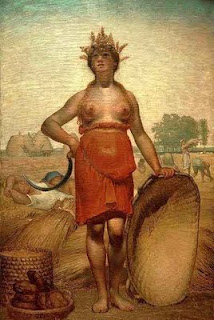
Her first plough-furrow opened the earth (Tellus' realm) to the world of men and created the first field and its boundary; she thus determined the course of settled, lawful, civilised life. She mediated between plebeian and patrician factions. She oversaw the transition of women from girlhood to womanhood, from unmarried to married life and motherhood and the growth of children from infancy. Despite her "chthonic" connections to Tellus, she was not, according to "Spaeth", an underworld deity. Rather, she maintained the boundaries between the realms of the living and the dead.
Given the appropriate rites, she would help the deceased into afterlife as an underworld shade ("Di Manes"): otherwise, the spirit of the deceased might remain among the living as a wandering, vengeful ghost.
The goddess was worshiped in many ways. There was the porca praecidanea, which involved sacrificing a fertile female pig and was necessary before a harvest. Cato indicates that sacrifices of any large food item will do, however, and suggests a pumpkin as an acceptable substitute for a pig, since it can be cut open and the seeds offered to Ceres in much the same way the entrails of the pig would be. After the offering of the "porca praecidanea", it was customary to also give the goddess a libation of wine.
The poor could offer wheat, flowers, and a libation. The expectations of afterlife for initiates in the "sacra Cereris" may have been somewhat different, as they were offered "a method of living" and of "dying with better hope".
Ceres' major festival was the Cerealia - the ludi cereales, culminating on April 19 to celebrate the growth of grain and other agricultural products. Its original form is unknown; it may have been founded during the regal era. During the Republican era, it was organised by the "plebeian aediles", and included "ludi circenses" (circus games). These opened with a horse race in the Circus Maximus, whose starting point lay just below the Aventine Temple of Ceres, Liber and Libera. In a nighttime ritual after the race, blazing torches were tied to the tails of live foxes, who were released into the Circus. The origin and purpose of this ritual are unknown; it may have been intended to cleanse the growing crops and protect them from disease and vermin, or to add warmth and vitality to their growth
Religiously, the purpose of the races and the games were to make the goddess favorably disposed toward the Roman people, so that she would give them a good harvest.
Visual depictions of Ceres were largely derived from Greek portrayals of Demeter. On two coin types, a bust of Ceres was pictured on one side, while a yoke of oxen was on the other. On other coins, she wears a crown of grain stalks called a "corona spicea", holds stalks of wheat, and is occasionally pictured with wheat and barley grains. One coin actually portrayed her wearing a modius, an instrument used to measure grain, on her head. Another pictures a bust of series on one side, and a pair of seated male figures with a wheat stalk to their side on the other. The seated men represent the official distribution of grain to the people. Annona, the goddess who personified the wheat supply, appears alongside Ceres on several coins from the imperial period. Reliefs from the Augustan period have even gone so far as to depict her as a plant growing out of the ground. In one her bust emerges from the earth, holding bunches of poppies and grain in her upraised hands while two snakes twine about her arms.
Ceres also assimilated the visual symbols of the Eleusinian Mysteries, which most Romans observed in her name. Ceres is depicted with symbols of the Mysteries, such as riding in a chariot drawn by snakes while holding a torch in her right hand.
Information collected from various sources.

Baphomet & Opfer
From Opfer, Fenrir Vol. II, no 2
The word 'opfer' generally refers to the sacrifice that occurs - symbolic
or otherwise - during certain rituals. There are, generally, two types of
opfer: (1) associated with rites to open a nexion (or 'Star Gate'), between
Aeons - when such an opfer(s) is considered necessary in terms of the
'energy' required;(2) those associated with traditional beliefs regarding
the 'working of the cosmos'.
('Opfers' associated with death rituals form a third type.)
The second type, according to tradition, was chosen once every 17 years and
this sacrifice was regarded as necessary to retain 'the cosmic balance' -
in modern terms, keep a nexion open (and thus preserve the associated
higher civilization etc). The chosen one was made an honourary Priest (this
type of opfer was always male) and there was a joining between him and one
or more women, as Priestesses. This joining was a simple type of
'hierosgamos', and the offspring of the union(s) were given great honour.
At the ceremony itself, the head of the opfer was severed and displayed -
usually for a night and a day (although this period may have been longer in
the very distant past). The Rite was conducted outdoors in a 'sacred' place
- often a circle of stones or hill top.
The chosen one was able, because of the sacrifice, to partake of an acausal
existence - becoming thus an Immortal. Thus 'willing sacrifice' was
possible, although it is easy to imagine that in later times, the opfer was
not so willing.
Traditionally, this type goes back to Albion, and while originally the
ritual was probably a community affair, it became more secretive. What
survives to the present day (The Ceremony of Recalling with 'opfer' ending)
probably reflects the essence of this earlier tradition rather than the
detail (the words, chants etc). This essence may be apprehended in the role
of the Mistress of Earth - representative of Baphomet, the Dark Goddess. It
was to Baphomet that the sacrifice was made - hence a male opfer. Indeed,
the whole ceremony (of Recalling) can be seen as a celebration of the dark
goddess - the Earth Mistress/goddess in her darker/violent/sinister aspect.
The severed head was associated with the worship of Baphoment - the cult
deriving from Albion - hence the traditional representation of Baphomet.
The identification of Baphomet as the Bride of Lucifer/Satan probably dates
from around the 10th or 11th century, as does the use of the name
'Satan'/Satanas as the Earth-bound representative of the Dark Gods.
It is important to remember that in earlier times (eg. in Albion during the
Hyperborean aeon) there was no clear and/or moral distinction between the
'light' and the 'sinister': the two were seen as different aspects of the
same thing. Thus, what we know as the Mistress of Earth (the 'goddess') was
both what we now call Baphomet (the dark aspect) and Gaia (the Earth
Mother). Likewise with the male aspect - Satan and Lucifer - or
Dionysus/Kabeiroi and Apollo. We now understand all such symbols as
unconscious/conscious projections onto 'reality' (where 'reality' = the
region of causal/acausal mergence) - as 'gates'/nexions to the acausal
itself, with the seven spheres of the Tree of Wyrd being a 'map' of these
gates understandable by 'non-Adept' consciousness. Thus, the sphere of
Mercury re-presents Lucifer/Satan - Mercury, Mars and Sun being "male"
spheres, and moon, Venus, Jupiter the "female" ones (Saturn beyond such
opposites - Chaos itself).
The cult of Baphomet was the worship of the dark aspect of the "female"
energies - where in this context, worship means a striving toward
understanding/conscious integration. Traces of the worship of the 'light'
aspect survive in the Septenary tradition in the name "Aktlal Maka" and the
natural form of the Nine Angles rite. The darker aspect survives, in
essence, in the Ceremony of Recalling and the traditions associated with
the Mistress of Earth and Baphomet. As to the original name of the goddess
in both her aspects, there is a tradition which gives 'Darkat' (early form
of Lilith) as the name used before Baphomet became the common usage.
However, 'Azanigin' has also been suggested - as has 'Aktlal Maka' for the
'light'/Gaia aspect, although both these are merely 20th century
suggestions, not based on any oral tradition. Some aspects of the cult of
the (dark) goddess are said to have survived into Greek times in the form
of the 'mystery cults' (qv Kabeiroi - and also Eleusis for the 'light'
aspect), this being an 'indirect survival', the 'modern' Septenary
tradition being a direct one, from Albion.
The use of the name 'Baphomet' probably derives from the 10th or 11th
century although the traditional pictorial representation of Baphomet is
undoubtedly much older. If there was an oral tradition connected with the
origin of the name Baphomet, it has been lost.
Thus, there are no indications as to the 'original' names of the 'light'
and 'sinister' elements on the 'male' side - known to us as 'Lucifer' and
'Satan'. These latter names probably also derive from around the 10th or
11th century - although 'Karu Samsu' (or something very similar) has been
suggested for the 'Lucifer' aspect and 'Sapanur' as the 'sinister' aspect.
The rites associated with the first type of opfer - such as 'The Sinister
Calling' - cannot be either dated with certainty or seen to be derived from
an earlier tradition. In all probability, they derive from the 12th or 13th
century, although it is quite possible that earlier versions/forms existed.
Some
have even considered The Sinister Calling as a later version of the
Ceremony of Recalling. Again, if there was an oral tradition, it has been
lost - all that remains are the rituals themselves.
The 'Black Mass' itself (and indeed most of the ceremonial rituals in The
Black Book of Satan) probably originated around the same time as the
Sinister Calling. The original Mass was said in Latin, although by the
middle of the 20th century a translated version had found its way into the
Black Book - of necessity, although some Latin chants remained.
NOTES: The significance of the 17 year cycle is unclear. In the past few
decades, some theories have been advanced, but they are unconvincing.
Aktlal Maka is a chant sometimes used in the natural Nine Angles Rite by
the Priestess if the glade has a spring of water. It means 'the flowing
waters of Earth' and is chanted in homage to Gaia since natural springs are
regarded as her children.
The 'mysteries of the Kabeiroi' (sometimes spelt Cabiri) is one of the
esoteric traditions associated with the Hellenic Aeon. In its original
form, 'the mysteries' concerned certain deities often represented in the
form of griffins and connected with the sea as well as Demeter - the
'mother Earth' or Gaia. According to esoteric tradition, the mysteries
concerned the Dark Gods - in various 'shapechanging' forms - and related
how Demeter gave the first Initiates of this tradition a crystal (later
venerated at a shrine near Thebes where a sacred grove to Demeter existed)
as well as showing how an individual, through various Rites which involved
Gaia, women, sacred marriage and so on, could be transformed to a different
realm of consciousness. This transformation, as in other Greek Mystery
Cults, was achieved mainly through personal involvement in
ritual/ceremonial action often of a mythological kind.
Later, this tradition became divided - Eleusis representing the
'Apollonian' element, the Kabeiroi the 'Dionysian' or darker aspects, for
it is said that all Initiates of the Cabiri had to have committed a crime
greater than common ones.
The mysteries of the Kabeiroi were often celebrated in mountain shrines
(certain combinations of rock and underground water being regarded as
sacred - that is, capable by their magickal power of transforming the
consciousness of individuals (cf. various sacred sites of the Yezidi who
upheld a more garbled version of Dark Gods tradition) and to reach these
shrines was considered part of the process of Initiation.
Greeks called the Kabeiroi the 'great gods'.
- Order of Nine Angles -
http://www.nasz-dom.net/

Frigga is as powerful as Odin and is the only god/goddess allowed to sit in Odin's high seat Hlidskjalf when he is not there. She can look out over the whole universe from there. There is nothing she does not know. But she is called the silent Goddess for she does not speak of what she knows.
* Frigga's name means LOVE.
* She lives in Fensalir which means "Marsh Halls.
* Frigga's children are Thor, Balder and Hodar.
* Her stepchildren are Heimdal, Tyr, Vidan and Skljoldr.
* Her magical tool is the distaff.
* Her animal totem is the goose.
Frigga's Handmaidens are:
* EIR: Goddess of Healing.
* HLIN: Goddess of Protection.
* GNA: Messenger Goddess.
* FULLA: Fertility Goddess.
* Also: LOFN, SJOFN, SYN, GEFJON, SNORTA, VAN and VOR.
The constellation Orion's Belt is known as Frigga's Distaff. The rotating stars at night are her spinning wheel. It is said that Frigga uses her spinning wheel to weave the clouds. She also sits at her spindle weaving the destinies of men and gods alike at the beginning of each new year.
If you wish the ask Frigga about your destiny, first build a rapport with her and her Berkana rune. She may tell you. But be careful. She knows all the destinies of men, women and gods. She knew the destiny of her son Balder. She knew he would die, and try as she would, with all her powers, she could not stop it. Do you really want to know your destiny? Ask her.
Frigg was a goddess associated with married women. She was called up by women to assist in giving birth to children, and Scandinavians used the plant Lady's Bedstraw (Galium verum) as a sedative, they called it Frigg's grass).
In Scandinavia the blessing of Frigga is still invoked for birthing women with a white candle, with the Berkana Rune etched in its side. The candle is used as a charm to ensure a safe delivery.
Source: Ellis Peterson
Popular Posts
-
Astraea: Italian goddess of truth and justice. Also known as Astria. Aradia: Italian witch goddess. She came to earth to teach her mother ...
-
"The goat idol of the "and the deity of the sorcerers' Sabbat. The name is composed of three abbreviations: Tem. ohp. Ab., *Te...
-
Tweet Svetovit is a supreme god. Among Western Slavs he was probably worshipped on equal terms with Perun and Svarog, but his warlike solar ...
-
Tweet Taken from: Otto Freiher von Reinsberg-D"uringsfeld, " Aberglaube-Sitten-Feste Germanischer Volker, das festliche Jahr ...


