
Sabbat. The name is composed of three abbreviations: Tem. ohp.
Ab., *Templi omnium hominum pacis abhas*, "the father of the
temple of universal peace among men."
Some authorities hold that Baphomet was a monstrous head, others
that it was a demon in the form of a goat. An account of a
veritable Baphometic idol is as follows:
[describing the Levi Baphomet, perhaps Levi's descript. -- tn]
A pantheistic and magical figure of the Absolute.
The torch placed between two horns, represents
the equilibrating intelligence of the triad. The
goat's head, which is synthetic, and unites some
characteristics of the dog, bull, and ass,
represents the exclusive responsibility of matter
and the expiation of bodily sins in the body.
The hands are human, to exhibit the sanctity of
labor; they make the sign of esotericism above and
below, to impress mystery on initiates, and they
point at two lunar crescents, the upper being white
and the lower black, to explain the correspondences
of good and evil, mercy and justice. The lower part
of the body is veiled, portraying the mysteries of
universal generation, which is expressed solely by
the symbol of the caduceus. The belly of the goat
is scaled, and should be colored green, the semi-
circle above should be blue; the plumage, reaching
to the breast, should be of various hues. The goat
has female breasts, and thus its only characteristics
are those of maternity and toil, otherwise the signs
of redemption. On its forehead, between the horns
and beneath the torch, is the sign of the microcosm,
or the pentagram with one beam in the ascendant,
symbol of human intelligence, which, placed thus
below the torch, makes the flame of the latter an
image of divine revelation. This Pantheos should
be seated on a cube, and its footstool should be a
single ball, or a ball and a triangular stool."
In" of Sorcery and "(1851), Thomas Wright
stated:
Another charge in the accusation of the Templars
seems to have been to a great degree proved by the
deposition of witnesses; the idol or head which
they are said to have worshipped, but the real
character or meaning of which we are totally unable
to explain. Many Templars confessed to having seen
this idol, but as they described it differently,
we must suppose that it was not in all cases
represented under the same form. Some said it was
a frightful head, with long beard and sparkling
eyes; others said it was a man's skull; some
described it as having three faces; some sait it
was of wood, and others of metal; one witness
described it as a painting (*tabula picta*)
representing the image of a man (*imago hominis*)
and said that when it was shown to him, he was
ordered to 'adore Christ, his creator.' According
to another deposition, the idol had four feet, two
before and two behind; the one belonging to the
order at Paris, was said to be a silver head, with
two faces and beard. The novices of the order
told always to regard this idol as their saviour.
Deodatus Jaffet, a knight from the south of France,
who had been received at Pedenat, deposed that the
person who in his case performed the ceremonies of
reception, showed him a head or idol, which
appeared to have three faces, and said, 'You must
adore this as your saviour, and the saviour of the
order of the Temple' and htat he was made to worship
the idol, saying, 'Blessed be he who shall save my
soul.' Cettus Ragonis, a knight received at Rome
in a chamber of the palace of the Lateran, gave a
somewhat similar account. Many other witnesses
spoke of having seen these heads, which, however,
were, perhaps, not shown to everybody, for the
greatest number of those who spoke on this subject,
said that they had heard speak of the head, but that
they had never seen it themselves; and many of them
declared their disbelief in its existence. A friar
minor deposed in England that an English Templar
had assured him that in that country the order had
four principal idols, one at London, in the Sacristy
of the Temple, another at Bristelham, a third at
Brueria (Bruern in Lincolnshire), and a fourth
beyond the Humber.
Some of the knights from the south added another
circumstance in their confessions relating to this
head. A templar of Florence, declared that, in
the secret meetings of the chapters, one brother
said to the others, showing them the idol, 'Adore
this head. This head is your God and your Mahomet.'
Another, Gauserand de Montpesant, said that the idol
was made in the figure of Baffomet (*in figuram
Baffometi*); and another, Raymond Rubei, described
it as a wooden head, on which was painted the figure
of *Baphomet*, and he adds, 'that he worshipped it
kissing its feet, and exclaiming *Xalla*,' which he
describes as 'a word of the Saracens' (*verbum
Saracenorum*). This has been seized upon by some
as proof that the Templars had secretly embraced
Mahometanism, as *Baffomet* or *Baphomet* is
evidently a corruption of Mahomet; but it must not
be forgotten that the Christians of the West
constantly used the word Mahomet in the mere
signification of an idol, and that it was the desire
of those who conducted the persecution against the
Templars to show their intimate intercourse with
the Saracens. Others, especially Von Hammer, gave
a Greek derivation of the word, and assumed it as a
proof that gnosticism was the secret doctrine of the
temple....
Some occultists have suggested that the Baphomet of the Templars
was really the god of the witches deriving from the nature god
Pan. During the nineteenth century, the Austrian Orientalist
Baron Joseph von Hammer-Purghstall discovered an inscription on
a coffer in Burgundy which he claimed showed that Baphomet
derived from two Greek words meaning "Baptism of Metis" {Wisdom}";
the inscription exalted Metis or Baphomet as the true divinity.
When Karl Kellner and other early twentieth-century German
occultists founded the secret order".T.O. (Ordo Templi Orientis
or Order of Templars in the East), they installed the British
occultist Aleister "as head of the British section, and
gave he gave himself the magical name of Baphomet.
Encyclopedia of Occultism and Parapsychology, 2nd Ed.,
edited and revised by Leslie Shepard, Gale Research
Company, 1984; pp. 131-2.
"Bataille" and "Margiotta" claimed that the order of the Palladium
or Sovereign Council of Wisdom was constituted in France in 1737,
and this, they inferred, was one and the same as the legendary
Palladium of the Templars, better known by the name of "In 1801 one Isaac Long, a Jew, was said to have carried the
"original image" of Baphomet to Charleston in the United States,
and it is alleged that the lodge he founded then became the chief
in the Ancient and Accepted Scotch Rite. He was succeeded in due
course by Albert Pike, who, it was alleged, extended the Scotch
Rite, and shared the Anti-Catholic Masonic chieftainship with the
Italian patriot Mazzini. This new directory was established, it
was asserted, as the new Reformed Palladium Rite or the Reformed
Palladium.
Ibid, p. 330.
"

FEELING ANXIOUS Altar cloths Purple Deities Demeter, Tara, Artemis, or Ganesh Candles Light blue Flowers Violets or anemones Stones Amethyst Scents Lavender, Eyebright, Sage Other Potted flowers, Drink chamomile mint tea
FEELING BLUE Altar cloths Pale pink Deities Brighid, or Mary Candles Yellow Flowers Violets Stones Rose quartz Scents Violet, Pine, Borage Other Sea shells
FEELING FEARFUL Altar cloths Light Blue Deities Artemis or Kali, Dancing Shiva or Pan Candles Yellow Flowers Chrysanthemum Stones Black hematite- no crystals! Scents Snapdragon, Eyebright, Basil Other Big pine cones
FEELING DESPAIRING Altar cloths Bright red Deities Kwan Yin, Mary, or Yemaya Candles White Flowers Tiger lilies Stones Pearl Scents Lavender, Rosemary, Mint, Borage Other River stones
FEELING STUCK Altar cloths Bright green Deities Dancing Shiva, Kali, Danu, or Brighid Candles Red Flowers Cuttings of green branches or flowering fruit trees Stones Quartz crystal Scents Motherwort, Mint, Mandrake, Basil, Anise Other Red ribbons on your athame
FEELING STRESSED Altar cloths Purple Deities Matron God/dess, Voluptus, or Lalita Candles Ivory pillar candles Flowers Pastel colours and green leaves Stones Hematite or amber Scents Vervaine, Thyme, Lavender Other Eat cucumbers
FEELING IRRITABLE Altar cloths Pale pink Deities Kuan Yin, Green Tara Candles Sky blue Flowers Narcissus or Daffodils Stones Moonstone Scents Tarragon, Passion Flower Other Drink Chamomile Tea
FEELING POOR Altar cloths Gold Deities Lakshmi, Gaia, or Moon Mother Candles Silver Flowers Lush garden roses or large bouquets, Hollyhocks Stones Rose quartz and pearl Scents Rowan, Alfalfa Other Fruits, nuts, bread pentacles
FEELING SPIRITUAL APATHY Altar cloths Black with stars (silver or gold) Deities Matron God/dess, or Tara Candles Silver, Gold, or Sky blue Flowers Yellow and pink roses Stones Turquoise Scents Sandalwood, Myrrh Other Decorate your chalice with flowers, colours, shiny things
FEELING A CREATIVE SLUMP Altar cloths Orange Deities Brighid, Saraswati Candles Turquoise (if you can stand it) or red Flowers Lotus, Water lilies, Orchids, Jasmine Stones Lapis Lazuli or Herkimer diamond Scents Vervaine, Mandrake, Jasmine Other Decorate with Stars
FEELING UNGROUNDED Altar cloths Brown Deities Gaia, Artemis/Diana, Green Man Candles Brown or Black Flowers Geraniums Stones Hematite Scents Wisteria Other Potted plants
NEEDING HEALING Altar cloths Spring Green Deities Green Tara, Hari, Medicine Buddha Candles Yellow Flowers Jasmine Stones Amethyst Scents Rosemary, Pine, Juniper, Jasmine, Hyssop, Ginger
WANTING LOVE Altar cloths Dusty rose Deities Aphrodite, Venus Candles Red Flowers Irises, Plush roses (red, peach, or pink) Stones Moonstone Scents Lovage, Rose, Vervaine, Rose Geranium, Periwinkle
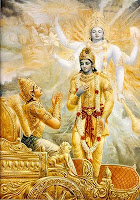
Notwithstanding these contentions, let us say that there is an axiom to the ancient astronaut theory. Then we need to ask, who were these beings? What did they represent to the inhabitants of earth? Where these beings the ancient Gods of antiquity?
I would like to periodically chronicle my speculation of how the native people interpreted these unknown entities. This edition describes "Krishna, The Divine Source".
Krishna is usually regarded as an avatar of Vishnu and in some traditions considered the Supreme Being. Lord Krishna is the embodiment of love and divine joy, that destroys all pain and sin. He is the protector of sacred utterances and cows. Krishna is an instigator of all forms of knowledge and born to establish the religion of love.
Tradition holds that Krishna saw Vishnu in a vision in which the former deity told Krishna to destroy Kamsa son of a demon, a tyrannical ruler of the world. Krishna's mother, Devaki, was Kamsa's half-sister. Kamsa already killed her first six sons because he had been told one of her sons would kill him. Krishna' elder brother, Devaki's seventh child, Balarama was miraculously saved by Vishnu.
Krishna was also saved when exchanged by his parents for the daughter of a herdsman Nanda and his wife Yasoda (the daughter was also a divine being, an incarnation of Maya). With his foster parents Krishna spent a happy life playing boyish pranks and seducing the gopis (cow girls) and other rustic maidens. They found his flute playing irresistible. Legend has it he may have had 16,000 wives. But his favorite was Radha, daughter of his foster father, and his childhood lover, although they did not marry.
According to legend Krishna was not only divine, but heroic as well. He is alleged to have defeated numerous dragons and monsters, and eventually as predicted, killed his half-uncle the tyrannical king Kamsa.
It was said that demi-gods or devas use to appear frequently to people and gave them technology and knowledge, they also interbred with the population. The Rishis were the keepers of the highest science and knowledge and they learned this from a "divine source".
Some examples of mortal and gods interaction:
Kunti got all her sons from the gods. She learnt how to summon these gods from a Rishi who gave her a mantra for each god. Also, Kunti's fathers grand father was actually a naga (shape shifting serpent)
Krishna's city of Dwarika and Ravans city of Lanka was built by Vishwakarma, who was the chief architect and engineer of the demi-gods. Vishwakarma was also to transport entire land masses. He also revealed the art of mechanical engineering and architecture to humans. And made the weapon "Agneyastra".
The demi-god Indra was where Arjuna (who was his son) obtained all his celestial futuristic weapons and his vimana (aeroplane).
Krishna, was "not of this Earth" and he knew all the demi-gods very well and they all revered him. In fact Krishna was implanted into the womb of mother of Krishna by a ray of light from the sky (virgin birth).
The story of Krishna also narrates the tale of how Shalva attacked the city of Dwarka with what appears to be a flying saucer.
On learning of Shishupala's death, his friend, Salva, invoked Shiva and secured from him a flying saucer, a vimana that could travel anywhere in the world, in air, on the ground, under the sea. Using this vimana, Salva launched an attack on Dwaraka determined to avenge his friend's death. Both Krishna and Balarama were in Indraprastha attending Yudhishtira's coronation when this happened. So the defence of the city was left to the other Yadavas. Dwaraka was pounded by missiles from the skies. Krishna's sons and grandsons put up a brave fight but were no match for Salva. When news of the aerial attack on Dwaraka reached Krishna, he hurried home and entered the battlefield immediately. First he shot an arrow with the Sharanga bow and brought Salva's vimana down as if it was a bird. He then hurled the Kaumodaki mace and smashed the vimana to dust. Then raising the Nandaka sword, he beheaded Salva. The Yadavas were jubilant in victory.
Even the Ramayana talks about a flying chariot called pushpaka-vimana. To many the account of this chariot is not poetic imagination but historical evidence that airplanes existed in Vedic times. The chariot belonged to the yaksha-king Kubera. Ravana took it by force after driving Kubera out of Lanka. Ravana used the chariot to abduct Sita. After killing Ravana and rescuing Sita, Rama returned to the city of Ayodhya on this flying chariot.
Gandhari cursed Lord Krishna that he would perish after thirty-six years, all alone and in a miserable state. All his followers, devotees, relatives and loved ones will also die simultaneously. When this time arrived in Krishna`s life; a madness seized the inhabitants of Dwaraka in such an extent that the people started to kill one another. All sons and grandsons of Krishna were also dead in the massacre. Only the women, Krishna and Balaram were alive in Dwaraka.
After a while Balaram isolated himself in a dense forest. Lord Krishna then went to his father, took blessings and left for the forest, where Balaram awaited him. He saw that his elder brother was sitting under a mighty tree on the fringes of the forest. Balaram was sitting in a posture of a Yogi, eventually a thousand headed snake, `Ananta naga` came out from his mouth and glided its way to the ocean. Soon, the ocean and other holy rivers came together to welcome Anant Naga into their realm.
Lord Krishna saw his brother depart from the real world and he started to wander in the forest. Finally he sat on the ground, started to think of Gandhari`s curse, and realized that the time for his departure has already arrived. He self-possessed his senses and concentrated on his Yoga. A hunter approached that spot of the forest and from a distant saw him and thought to be a deer. He loosed his shaft, took out the arrow, and mistakenly pierced Lord Krishna`s foot. He came hurried near to the Lord and saw him to be a man wrapped in yellow robes practicing yoga. The hunter immediately touched the feet of Lord Krishna and asked for apology.
Lord Krishna opened his eyes and comforted the hunter, then ascended towards the heaven, thus filling the whole sky with glory. After passing through Indra`s paradise, he reached his place at even higher strata. Krishna wives; including Rukmini became Sati and burned themselves on pyre. The rest of the women of Dwaraka became ascetics and nuns. After each and every living being of Dwaraka moved away to other places, the ocean came about and engulfed the city, thus leaving no trace of the land of Lord Krishna.
Baphomet & Opfer
From Opfer, Fenrir Vol. II, no 2
The word 'opfer' generally refers to the sacrifice that occurs - symbolic
or otherwise - during certain rituals. There are, generally, two types of
opfer: (1) associated with rites to open a nexion (or 'Star Gate'), between
Aeons - when such an opfer(s) is considered necessary in terms of the
'energy' required;(2) those associated with traditional beliefs regarding
the 'working of the cosmos'.
('Opfers' associated with death rituals form a third type.)
The second type, according to tradition, was chosen once every 17 years and
this sacrifice was regarded as necessary to retain 'the cosmic balance' -
in modern terms, keep a nexion open (and thus preserve the associated
higher civilization etc). The chosen one was made an honourary Priest (this
type of opfer was always male) and there was a joining between him and one
or more women, as Priestesses. This joining was a simple type of
'hierosgamos', and the offspring of the union(s) were given great honour.
At the ceremony itself, the head of the opfer was severed and displayed -
usually for a night and a day (although this period may have been longer in
the very distant past). The Rite was conducted outdoors in a 'sacred' place
- often a circle of stones or hill top.
The chosen one was able, because of the sacrifice, to partake of an acausal
existence - becoming thus an Immortal. Thus 'willing sacrifice' was
possible, although it is easy to imagine that in later times, the opfer was
not so willing.
Traditionally, this type goes back to Albion, and while originally the
ritual was probably a community affair, it became more secretive. What
survives to the present day (The Ceremony of Recalling with 'opfer' ending)
probably reflects the essence of this earlier tradition rather than the
detail (the words, chants etc). This essence may be apprehended in the role
of the Mistress of Earth - representative of Baphomet, the Dark Goddess. It
was to Baphomet that the sacrifice was made - hence a male opfer. Indeed,
the whole ceremony (of Recalling) can be seen as a celebration of the dark
goddess - the Earth Mistress/goddess in her darker/violent/sinister aspect.
The severed head was associated with the worship of Baphoment - the cult
deriving from Albion - hence the traditional representation of Baphomet.
The identification of Baphomet as the Bride of Lucifer/Satan probably dates
from around the 10th or 11th century, as does the use of the name
'Satan'/Satanas as the Earth-bound representative of the Dark Gods.
It is important to remember that in earlier times (eg. in Albion during the
Hyperborean aeon) there was no clear and/or moral distinction between the
'light' and the 'sinister': the two were seen as different aspects of the
same thing. Thus, what we know as the Mistress of Earth (the 'goddess') was
both what we now call Baphomet (the dark aspect) and Gaia (the Earth
Mother). Likewise with the male aspect - Satan and Lucifer - or
Dionysus/Kabeiroi and Apollo. We now understand all such symbols as
unconscious/conscious projections onto 'reality' (where 'reality' = the
region of causal/acausal mergence) - as 'gates'/nexions to the acausal
itself, with the seven spheres of the Tree of Wyrd being a 'map' of these
gates understandable by 'non-Adept' consciousness. Thus, the sphere of
Mercury re-presents Lucifer/Satan - Mercury, Mars and Sun being "male"
spheres, and moon, Venus, Jupiter the "female" ones (Saturn beyond such
opposites - Chaos itself).
The cult of Baphomet was the worship of the dark aspect of the "female"
energies - where in this context, worship means a striving toward
understanding/conscious integration. Traces of the worship of the 'light'
aspect survive in the Septenary tradition in the name "Aktlal Maka" and the
natural form of the Nine Angles rite. The darker aspect survives, in
essence, in the Ceremony of Recalling and the traditions associated with
the Mistress of Earth and Baphomet. As to the original name of the goddess
in both her aspects, there is a tradition which gives 'Darkat' (early form
of Lilith) as the name used before Baphomet became the common usage.
However, 'Azanigin' has also been suggested - as has 'Aktlal Maka' for the
'light'/Gaia aspect, although both these are merely 20th century
suggestions, not based on any oral tradition. Some aspects of the cult of
the (dark) goddess are said to have survived into Greek times in the form
of the 'mystery cults' (qv Kabeiroi - and also Eleusis for the 'light'
aspect), this being an 'indirect survival', the 'modern' Septenary
tradition being a direct one, from Albion.
The use of the name 'Baphomet' probably derives from the 10th or 11th
century although the traditional pictorial representation of Baphomet is
undoubtedly much older. If there was an oral tradition connected with the
origin of the name Baphomet, it has been lost.
Thus, there are no indications as to the 'original' names of the 'light'
and 'sinister' elements on the 'male' side - known to us as 'Lucifer' and
'Satan'. These latter names probably also derive from around the 10th or
11th century - although 'Karu Samsu' (or something very similar) has been
suggested for the 'Lucifer' aspect and 'Sapanur' as the 'sinister' aspect.
The rites associated with the first type of opfer - such as 'The Sinister
Calling' - cannot be either dated with certainty or seen to be derived from
an earlier tradition. In all probability, they derive from the 12th or 13th
century, although it is quite possible that earlier versions/forms existed.
Some
have even considered The Sinister Calling as a later version of the
Ceremony of Recalling. Again, if there was an oral tradition, it has been
lost - all that remains are the rituals themselves.
The 'Black Mass' itself (and indeed most of the ceremonial rituals in The
Black Book of Satan) probably originated around the same time as the
Sinister Calling. The original Mass was said in Latin, although by the
middle of the 20th century a translated version had found its way into the
Black Book - of necessity, although some Latin chants remained.
NOTES: The significance of the 17 year cycle is unclear. In the past few
decades, some theories have been advanced, but they are unconvincing.
Aktlal Maka is a chant sometimes used in the natural Nine Angles Rite by
the Priestess if the glade has a spring of water. It means 'the flowing
waters of Earth' and is chanted in homage to Gaia since natural springs are
regarded as her children.
The 'mysteries of the Kabeiroi' (sometimes spelt Cabiri) is one of the
esoteric traditions associated with the Hellenic Aeon. In its original
form, 'the mysteries' concerned certain deities often represented in the
form of griffins and connected with the sea as well as Demeter - the
'mother Earth' or Gaia. According to esoteric tradition, the mysteries
concerned the Dark Gods - in various 'shapechanging' forms - and related
how Demeter gave the first Initiates of this tradition a crystal (later
venerated at a shrine near Thebes where a sacred grove to Demeter existed)
as well as showing how an individual, through various Rites which involved
Gaia, women, sacred marriage and so on, could be transformed to a different
realm of consciousness. This transformation, as in other Greek Mystery
Cults, was achieved mainly through personal involvement in
ritual/ceremonial action often of a mythological kind.
Later, this tradition became divided - Eleusis representing the
'Apollonian' element, the Kabeiroi the 'Dionysian' or darker aspects, for
it is said that all Initiates of the Cabiri had to have committed a crime
greater than common ones.
The mysteries of the Kabeiroi were often celebrated in mountain shrines
(certain combinations of rock and underground water being regarded as
sacred - that is, capable by their magickal power of transforming the
consciousness of individuals (cf. various sacred sites of the Yezidi who
upheld a more garbled version of Dark Gods tradition) and to reach these
shrines was considered part of the process of Initiation.
Greeks called the Kabeiroi the 'great gods'.
- Order of Nine Angles -
http://www.nasz-dom.net/
Popular Posts
-
Astraea: Italian goddess of truth and justice. Also known as Astria. Aradia: Italian witch goddess. She came to earth to teach her mother ...
-
"The goat idol of the "and the deity of the sorcerers' Sabbat. The name is composed of three abbreviations: Tem. ohp. Ab., *Te...
-
Tweet Svetovit is a supreme god. Among Western Slavs he was probably worshipped on equal terms with Perun and Svarog, but his warlike solar ...
-
Tweet Taken from: Otto Freiher von Reinsberg-D"uringsfeld, " Aberglaube-Sitten-Feste Germanischer Volker, das festliche Jahr ...


