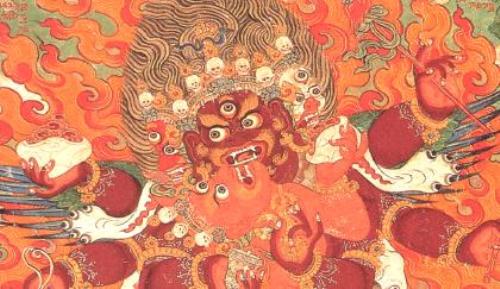
The wrathful deities are the powerful counterparts of the peaceful deities. Like demonic monsters we commonly see in films, they capture the spirit of the dead and try to drink its blood (which symbolize one's desires and passions) from cups made out of human skull. Because these visions are so intensely frightening, the consciousness of the dead person tries to get away from them, eventually descending into the lower realms of the after death state until it is propelled to its proper place for rebirth. More on the gory details later.
Another characteristic of the wrathful deities of the bardo is that of having animal heads with human bodies which is something particularly comparable to the gods of ancient Egypt such as Horus (falcon), Thoth (ibis), Anubis (jackal), Bastet (cat), Hathor (cow), Khnum (ram), and Serket (scorpion). Like the animal-headed deities from the Egyptian pantheon, the wrathful deities also have symbolic meanings which can be deciphered by studying what the corresponding animals represent.
Are the Wrathful Deities real?
What is their purpose?
As mentioned in the previous article, all the peaceful and wrathful deities are only archetypal images of the mind that have no reality of their own. They are empty and cannot harm the body of an enlightened awareness. All the blood-drinking and animal-headed deities of the bardo are mere projections of the intellect and they emerge from the four directions of the third eye chakra.
However, since it was mentioned that the consciousness of the dead person is already capable of having sensory awareness after it has gone through the first bardo, it experiences the vision of the wrathful deities in full realistic horror, even more unbearable and dreadful than The Exorcist, The Ring, or A Nightmare on Elm Street in 4D. Wait... 4D?
Now, the effect of the images becomes even stronger if the awareness-body tries to evade or reject them. This is not good news for the dead person because evading or rejecting these visions would cause its consciousness to descend into unconsciousness. This basically means that instead of having power over these entities by accepting them as aspects of your own consciousness, they gain power over you. Figuratively speaking, all the demons hide inside the subconscious and wield their influence in your life now because before you were born, your consciousness wasn't strong enough to overcome them in the after death state (assuming you accept rebirth as part of your belief system). It is, therefore, reasonably important for spiritual practitioners in Tibetan Buddhism and other traditions to pay attention to this fact during their lifetime and distinguish these hidden aspects of consciousness to avoid being overwhelmed once they leave this world.
According to the Tibetan Book of the Dead, all the wrathful deities appear in order to purify awareness of false thinking, ignorance, and delusion. Any kind of reaction that is the result of fear is a movement towards rebirth. If you are able to recognize the deities by name and see through them as mere illusions, they instantly lose their power over your consciousness and you achieve liberation.
The Vision of the Wrathful Deities
(12th to 19th DAY)
All the deities you will see here are the polar opposites of the peaceful deities. The wrathful deities appear on a lotus-sun throne of the forehead mandala (third eye chakra) and stand in a blazing aureole of flames. Since they are quite numerous, I can only provide a short description for each group of deities. If you are interested to know more about them, you can search their names on Google/Wikipedia or, even better, read the English translations of the Tibetan Book of the Dead. Also, it's quite hard to find pictures that exactly fit the descriptions I have, so forgive me if this creates a little bit of confusion.
1. THE POWERFUL MAHASRI-HERUKA
"
Mahasri-Heruka"
The visions start with Mahasri-Heruka, the lord of the "blood-drinking deities." He is the tremendously wrathful expression of Adibuddha (the source of all the buddhas and bodhisattvas in the bardo). Mahasri-Heruka is usually depicted as red-brown in color with three heads, nine eyes, six arms, and four legs surrounded by a ring of flames. His right face is the color of smoke, the middle is white, and the left is red. In his three right hands he carries a short metal weapon called vajra, a trident, and a drum with a handle. In his left hands he carries a bell, a skull cup, and a sling made from innards. The powerful Heruka is usually depicted in tantric union or "yab yum" with his dakini, whose color is pure white. Like the Adibuddha, the powerful Mahasri-Heruka occupies a special position among the bardo deities and all of the symbols associated with him have specific meanings.
2. THE FIVE BLOOD-DRINKING DEITIES
"
The Five Blood-Drinking Deities"
The next vision involves the Five Blood-Drinking deities (a.k.a. Buddha-Herukas) in tantric union with their five dakinis. Their purpose is to annihilate the five principal failings of human behavior (ignorance, hatred, pride, passion, and envy) while the five dakinis enlighten the five elemental realms (earth, water, fire, air, ether). All of them have three heads, six arms, and four legs and are adorned with crowns of skulls and skull-necklaces. They are usually depicted in paintings with wings of the garuda bird, a mythical bird that symbolizes the power to overcome evil.
1. BUDDHA-HERUKA - appears in the center with his smoky-white dakini Krodhesvari. This wrathful Heruka is an emanation of Buddha Vairocana, manifesting himself in a terrifying flaming form. In his right hands he carries a long-handled axe, a flaming sword, and the wheel of the teachings; in his left, a kapala, a ploughshare, and a bell.
2. VAJRA- HERUKA (dark blue ) - appears in the east with his dakini Vajra-Krodhesvari
3. RATNA-HERUKA (yellow) -appears in the south with his dakini Ratna-Krodhesvari
4. PADMA-HERUKA (red) - appears in the west his dakini Padma-Krodhesvari
5. KARMA-HERUKA (green) - appears in the north with his dakini Karma-KrodhesVari
Note: The descriptions do not match the picture.
3. THE EIGHT KEURIMA ">
The next vision involves the eight Keurima and the eight animal-headed Phramenma. All of these deities originate from the various regions of the head. They wear leopard-skins and hover in empty space, surrounded by blazing flames. They should not be feared, but instead be considered as mere projections of the mind. Psychologically, they have the same purpose as the Eight Mahabodhisattvas and their Dakinis.
The Keurima are the counterparts of the Eight Mahabodhisattvas from the mandala of the peaceful deities. Their sole purpose is to purify and enlighten the eight kinds of awareness (the psychic organs of perception). The Keurima are divided into two groups. The first group of dakinis is of the cardinal directions of the mandala and of pure colors. The other four are of the intermediate directions with mixed colors.
The Phramenma are the eight animal-headed deities who rule over the eight realms of consciousness (the corresponding physical organs of perception). They are the wrathful counterparts of the eight dakinis of the Eight Mahabodhisattvas. Four of the Phramenma have animal heads and they correspond to the four cardinal directions of the eight-petalled lotus. The other four have bird heads and correspond to the intermediate directions.
4. THE FOUR ANIMAL-HEADED FEMALE GUARDIANS OF THE MANDALA
The next vision involves the Four Animal-Headed Female Guardians. Their purpose is to indicate to the dead person its four boundaries. These boundaries represent the "Four Sublime States" (compassion, loving-kindness, sympathetic joy, and equanimity).
5. THE 28 ANIMAL-HEADED DEITIES
Finally, the awareness-body comes face to face with the rest of the crew, the 28 powerful Animal-headed Deities who are enjoying their sumptuous banquet of corpses, internal organs, and blood. Their purpose is to help consciousness to overcome any remaining false ideas and karmic hindrances so that it may be freed from all passions and attachments.
THE END OF THE CHONYID BARDO VISIONS
During the entire period of the Chonyid Bardo experience, the lama or guru keeps on reminding the consciousness of the dead person through the death ritual how important it is to recognize these images as one's own thought-forms even if he spent years of his life studying scriptures or practicing tantric techniques. Failure to do so at this point means failure to achieve liberation or moksha/buddhahood. Also, if one flees from the thought-forms out of fear all-throughout the visual experience of the wrathful deities, all of them will finally transform to the most powerful and terrifying aspect of the Lord of Death, Dharma-Raja, who represents ignorance, hate, and greed. The peaceful deities, on the other hand, turn into a powerful protective deity called Mahakala representing wisdom and enlightenment, although still wrathful in form.
"They will come having their upper teeth biting the nether lip; their eyes glassy; their hairs tied up on the top of the head; big-bellied, narrow-wasted; holding a karmic record-board in the hand; giving utterance from their mouth to sounds of 'Strike! Slay!', licking human brain, drinking blood, tearing heads from corpses, tearing out the hearts..."
Source: http://www.summum.us/mummification/tbotd/book1.shtml
Now you can just imagine how this can turn out to be such a bad day for the dead person without someone reminding him that it is not real. This is also why sacrifices and prayers are given as part of the death ritual just so the dead can make it through the dangers of the afterlife. From a psychological standpoint, these visions are seen as the processes of instinctual life, the repressed emotions, and the core patterns of memory and perception that are hidden from our consciousness. Carl Jung refers to this process, taking place in real life, as an encounter with the shadow. When this happens, the elements that occupy the unconscious mind try to penetrate consciousness and force the individual to face his own demons which are projected into the outside world. For Buddhists, the only way to overcome this in life, or even in death, is through the expansion of one's consciousness. In the next article, I will discuss the Sidpa Bardo wherein the journey through the six realms of existence and the search for the next place of rebirth take place. Say your prayers before going to bed, ayt?
Read all the articles in the Buddha Mind series.
Notwithstanding these contentions, let us say that there is an axiom to the ancient astronaut theory. Then we need to ask, who were these beings? What did they represent to the inhabitants of earth? Where these beings the ancient Gods of antiquity?
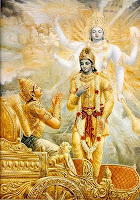
I would like to periodically chronicle my speculation of how the native people interpreted these unknown entities. This edition describes "Krishna, The Divine Source".
Krishna is usually regarded as an avatar of Vishnu and in some traditions considered the Supreme Being. Lord Krishna is the embodiment of love and divine joy, that destroys all pain and sin. He is the protector of sacred utterances and cows. Krishna is an instigator of all forms of knowledge and born to establish the religion of love.
Tradition holds that Krishna saw Vishnu in a vision in which the former deity told Krishna to destroy Kamsa son of a demon, a tyrannical ruler of the world. Krishna's mother, Devaki, was Kamsa's half-sister. Kamsa already killed her first six sons because he had been told one of her sons would kill him. Krishna' elder brother, Devaki's seventh child, Balarama was miraculously saved by Vishnu.
Krishna was also saved when exchanged by his parents for the daughter of a herdsman Nanda and his wife Yasoda (the daughter was also a divine being, an incarnation of Maya). With his foster parents Krishna spent a happy life playing boyish pranks and seducing the gopis (cow girls) and other rustic maidens. They found his flute playing irresistible. Legend has it he may have had 16,000 wives. But his favorite was Radha, daughter of his foster father, and his childhood lover, although they did not marry.
According to legend Krishna was not only divine, but heroic as well. He is alleged to have defeated numerous dragons and monsters, and eventually as predicted, killed his half-uncle the tyrannical king Kamsa.
It was said that demi-gods or devas use to appear frequently to people and gave them technology and knowledge, they also interbred with the population. The Rishis were the keepers of the highest science and knowledge and they learned this from a "divine source".
Some examples of mortal and gods interaction:
Kunti got all her sons from the gods. She learnt how to summon these gods from a Rishi who gave her a mantra for each god. Also, Kunti's fathers grand father was actually a naga (shape shifting serpent)
Krishna's city of Dwarika and Ravans city of Lanka was built by Vishwakarma, who was the chief architect and engineer of the demi-gods. Vishwakarma was also to transport entire land masses. He also revealed the art of mechanical engineering and architecture to humans. And made the weapon "Agneyastra".
The demi-god Indra was where Arjuna (who was his son) obtained all his celestial futuristic weapons and his vimana (aeroplane).
Krishna, was "not of this Earth" and he knew all the demi-gods very well and they all revered him. In fact Krishna was implanted into the womb of mother of Krishna by a ray of light from the sky (virgin birth).
The story of Krishna also narrates the tale of how Shalva attacked the city of Dwarka with what appears to be a flying saucer.
On learning of Shishupala's death, his friend, Salva, invoked Shiva and secured from him a flying saucer, a vimana that could travel anywhere in the world, in air, on the ground, under the sea. Using this vimana, Salva launched an attack on Dwaraka determined to avenge his friend's death. Both Krishna and Balarama were in Indraprastha attending Yudhishtira's coronation when this happened. So the defence of the city was left to the other Yadavas. Dwaraka was pounded by missiles from the skies. Krishna's sons and grandsons put up a brave fight but were no match for Salva. When news of the aerial attack on Dwaraka reached Krishna, he hurried home and entered the battlefield immediately. First he shot an arrow with the Sharanga bow and brought Salva's vimana down as if it was a bird. He then hurled the Kaumodaki mace and smashed the vimana to dust. Then raising the Nandaka sword, he beheaded Salva. The Yadavas were jubilant in victory.
Even the Ramayana talks about a flying chariot called pushpaka-vimana. To many the account of this chariot is not poetic imagination but historical evidence that airplanes existed in Vedic times. The chariot belonged to the yaksha-king Kubera. Ravana took it by force after driving Kubera out of Lanka. Ravana used the chariot to abduct Sita. After killing Ravana and rescuing Sita, Rama returned to the city of Ayodhya on this flying chariot.
Gandhari cursed Lord Krishna that he would perish after thirty-six years, all alone and in a miserable state. All his followers, devotees, relatives and loved ones will also die simultaneously. When this time arrived in Krishna`s life; a madness seized the inhabitants of Dwaraka in such an extent that the people started to kill one another. All sons and grandsons of Krishna were also dead in the massacre. Only the women, Krishna and Balaram were alive in Dwaraka.
After a while Balaram isolated himself in a dense forest. Lord Krishna then went to his father, took blessings and left for the forest, where Balaram awaited him. He saw that his elder brother was sitting under a mighty tree on the fringes of the forest. Balaram was sitting in a posture of a Yogi, eventually a thousand headed snake, `Ananta naga` came out from his mouth and glided its way to the ocean. Soon, the ocean and other holy rivers came together to welcome Anant Naga into their realm.
Lord Krishna saw his brother depart from the real world and he started to wander in the forest. Finally he sat on the ground, started to think of Gandhari`s curse, and realized that the time for his departure has already arrived. He self-possessed his senses and concentrated on his Yoga. A hunter approached that spot of the forest and from a distant saw him and thought to be a deer. He loosed his shaft, took out the arrow, and mistakenly pierced Lord Krishna`s foot. He came hurried near to the Lord and saw him to be a man wrapped in yellow robes practicing yoga. The hunter immediately touched the feet of Lord Krishna and asked for apology.
Lord Krishna opened his eyes and comforted the hunter, then ascended towards the heaven, thus filling the whole sky with glory. After passing through Indra`s paradise, he reached his place at even higher strata. Krishna wives; including Rukmini became Sati and burned themselves on pyre. The rest of the women of Dwaraka became ascetics and nuns. After each and every living being of Dwaraka moved away to other places, the ocean came about and engulfed the city, thus leaving no trace of the land of Lord Krishna.

It would seem that one of the divergent capabilities of mastering the discipline of theurgia would be the animation of a statue with a spirit. I say divergent because the aforementioned book doesn't present this capability as either an important or a critical point in the overall exposition. I would assume that the author in antiquity, briefly referring to this magickal effect, was stating what could be possible when pursuing the really important task of spiritual ascension and union with the One. I will quote the requisite passage to reveal that although mentioned, the what, where and how is mysteriously omitted.
"I mean statues, but statues living and conscious, filled with the breath of life, and doing many mighty works.."
The Church condemned this belief as a form of idolatry and saw it as the obvious worship of demons, even though many church statues were considered icons that had the power to bestow blessings and miraculous healing. The church would perform a kind of consecration, where a newly erected statue of a saint or an apostle would be blessed with holy water and incense during a votive mass, but it was the unquestioning faith of the people who saw these statues as emblems of divine power and grace that made them truly holy relics. Renaissance magicians, however, had no problem using unsanctioned statues and other devices for their reconstitution of Hermetic magick, but few had ever really written down (as far as I am aware) directions that would show how to make such a thing.
Years ago, as a ritual magician of no small ability, I decided to see if I could figure out how to do this operation within the context of my own system of magick. Not only was I intrigued by the Hermetic legend, but I also was exposed to the "statue as god" practices from a friend who was deeply involved in Voudoun and Santeria. I was also exposed to Michael Bertiaux and some of his heterodoxical voudoun and European magick. Still, I needed to develop a methodology that would work within my own personal system.
Basically, I concluded that the requirements for crafting a statue that housed an aspect of the Godhead would have the following requirements:
1. An appropriate statue of that deity or some other analogous form made out stone or metal,
2. To place an energy field into the statue that would be perpetual, self-regenerating and whose characteristics would be analogous to the aspect of Godhead,
3. Perform a Godhead invocation through a gateway structure that would draw that Godhead and powerfully associate it with the statue,
4. Engage the statue in a mystery working where that Godhead aspect can communicate, bless and empower me and whatever else I magickally seek to impact.
So the first task would be to find an appropriate statue made out a material that would be amendable to the working. That would eliminate anything that is made out plaster, plastic or cheap metal (aluminum). It would also make the statue more expensive and perhaps even something of an object d'art. I had three statues that were made out of pressed alabaster, and therefore, were perfect for this work. They could also be made out pressed resin as well, since a lot of beautiful museum replicas are made out that substance these days.
The second requirement was, at first, something of a conundrum. How would I apply a perpetual charge to the statue. I thought this over and came to the conclusion that I could charge the statue like it was a talisman, which in sense, it was. The best charging mechanism that I had in my repertoire was the generation of a talismanic elemental, which is the combination of a planetary intelligence fused within an element charge. A talismanic elemental can also be invoked as one of the Enochian Seniors, as well as one of the Lunar Mansions. I chose to work with this specific perpetual charge as both an energy and a spirit, thus embodying the statue with a base line energy field that would hold and contain the particular godhead that I sought to invoke into it. So for each of the three statues, I would choose a specific talismanic elemental charge. I had a total of twenty-eight different constructs from which to choose. Timing would be an important factor, which meant that I wouldn't be able to perform the invocation of the talismanic elementals whenever I chose, but it would have to be done when the Moon was waxing and when it entered into the targeted Lunar Mansion.
My three goddess statues provided me with the inspiration to choose the planet Venus for a talismanic elemental for each, so I chose Venus of Fire, Venus of Water and Venus of Air. Thus I had the charge determined for these three statues. The working called for a fourth talismanic elemental to be invoked and set to charge a special consecrated crystal - for that, I chose Venus of Earth. So all four element variations of Venus had been selected to be used in this working. Now on to the next step, where I would have to figure out how to do a Godhead invocation and somehow get it to materialize in the statue.
The key to getting an aspect of the Godhead to dwell in a statue was to be found in the ancillary rite used by the order to set a talismanic charge, called the Talismanic Elemental Application rite. This rite sets up a proper and powerful field in the target object that is to be charged. I will quote a section from that rite, which will establish the base for the applying of a charge, and help us visualize and determine the next step.
"The basic structure of this ritual consists of an Inverted Pentagram of Spirit Feminine that is set in the center of the circle, representing the Holy Feminine Spirit descending and bestowing its manifest blessings. This central power object is surrounded by a potent vortex that is generated with four hexagrams erected in the four Angles. The object to be charged is placed upon the sigil of the Talismanic Elemental in the center of the circle. The magician may use a central altar to perform this operation and focus the rite."
So an inverted pentagram of spirit feminine is set in the center of the circle in the ultra-point, symbolizing the descent of grace and spiritual power into a material frame work, which is the target object. There is also a vortex consisting of four unicursal hexagrams in the four angles, embedded in a crossroads energy structure with another unicursal hexagram set to the infra-point, energizing the nexus point where the crossroads meet. The hexagrams set in the four angles are drawn to invoke the planetary intelligence of the Sun, and the one in the center of the circle is set to the Moon - thus creating a powerful vortex polarity of Light and Darkness, Solar and Lunar aspects.
As a form of preparation, the statue is sprinkled with holy or lustral water and then anointed with holy oil. These sacraments have been prepared through a votive mass. Other sacraments, such as wine and a host, may be kept in reserve after the Mass to use in this working.
Using the powerful ritual structure that is already in place, the magician then performs a ritual to summon the Godhead, in this case, one of the three Goddesses that I sought to work with. I will quote from the directions in the ritual "Enneagramic Gate of the Goddess."
"The Celebrant then draws a great [Rose] Ankh in the Ultrapoint and seals it with a colored energy, depending on the nature of the Deity. The Celebrant then intones the Invocation of the Goddess and implores her to manifest and reside (in part) within the Eidolon - which the statue has now become.
When the above steps are completed for each of the Eidolons, the Celebrant shall light an offering of incense before it and then proceeds to anoint the statue a second time, thus sealing the power [and spirit of the godhead] into it."
In addition, the magician may also give or feed the statue an offering consisting of a consecrated host particle dipped in consecrated wine. The statue is now fully activated and has a resident aspect of the Godhead fully active within it. It will, of course, require periodic feeding and rites of devotion and adoration, but that is the responsibility of the magician as priest. It is an obligatory part of his or her personal magickal religious cult, and should never be neglected. What I have done at this point in the working is set up a shrine of the three goddesses, and decorated it with power objects, other god statues (to keep them company), and periodically gave them offerings of flowers, incense and devotions, and consecrated sacrament to feed and keep them active.
The Fourth and final step is engaging the living statue in some kind of powerful mystery rite, one where that Godhead can be deeply and magnificently integrated into the spiritual process of the magician. How this is done is to incorporate a gateway of the mysteries and build a kind of mystikon (telesterion) where the Deity may intimately commune with the magician. Because I chose three goddesses who had a special primacy in my personal pantheon, I used a triple gateway consisting of nine points, or an Enneagram to establish a mystikon for all three of them. What this structure looks like is quite simple. It consists of a Western Gateway, a Southern Gateway and a Northern Gateway. You can consider that the west is the gate of darkness, the south is the gate of the summer solstice (ascension of light), and the north, is the gate of the winter solstice (death and rebirth).
An enneagram gateway structure is erected only when all three of the statues have been completely animated with the charged aspect of the Godhead, so until that task is completed, the triple gateway mystery can't be done. Thus this rite of the triple gateway is performed with all three active goddess statues. Each gateway is erected and established for each of the three goddesses, starting with the north, then the west, and completing with the south. In this manner, an anticlockwise progression is established, producing a further vortex-like energy signature. The magician has now progressed through three gateways and is at the very center of the triple mysteries associated with the triple godhead. Achieving this point is quite a momentous and powerful magickal experience, but there is still more that needs to be done.
The magician then invokes the Talismantic Elemental of Venus of Earth and uses the Application Ritual to charge a specially selected crystal placed in the center of the circle. This can be done prior to the working, or it can be done in the very center of the working. I chose to make this talisman prior to the triple gateway, so instead of building up yet another structure in the center of the circle, I just brought out the crystal and set it up with the three statues of the goddess in their shrine, as mentioned previously.
Once this is done, then the magician takes the transmutar wand and draws all nine nodes of the gate structures together through the center of the circle in the ultra-point beginning with the Western Watchtower, and then ending after transiting the Northwest, North, Southeast, South, and Southwest. Now the enneagram is fully established and all four element aspects of the talismanic elemental of Venus are deployed.
When all three gateways are established, then the magician sets an inner circle in the center of the consecrated magick circle, proceeding in a sunwise direction. This inner circle has the quality of fusing all of the three gateways into a singularity, and the sunwise direction establishes a counter movement against the negative vortex, intensifying the energy at the center. An enneagramic trigon is placed in the center of the circle to establish the confluence of the nine points of the triple gateway.
Finally, the magician performs the opening of the portal gesture before the inner circle and steps into it. Then he or she declares the combined gateway keyword formula for all three gates and summons the combined power of the triple godhead. This completes the erection of the inner mystikon, and the magician then sits in the center of the circle and meditates in silence while communing with the combined godhead. He/She may place before that Deity composite shrine offerings and also sigils of his or her personal desires. When this communion is at an end, the magician backs out of the center of the circle and bows low before it. The three gateways are then sealed with sealing spirals, locking them for future use.
The final action is where the magician erects and projects an Eastern Gateway that represents an ascension into the light, as well as an exteriorization of all that was established in the mystikon. The ritual may be completed, but it can be revisited whenever the magician has need of communing with the triple powers of the combined Deity, through the artifice of three fully animated and empowered statues of the Godhead. To revisit, the magician performs a macro rite, that consists of the basic elements of the mystikon rite without all of the elaborate structures that were required to erect it the first time.
So that's my detailed solution to fully animating a statue with a summoned and invoked Godhead aspect. I have tested it and the methodology works quite well. What this does is add a potent dimension to the devotions and priest-like obligations of the magician, and it gives him or her the ability to go directly to the Godhead and request any kind of assistance, guidance, council or just reassurance. It also makes the temple environment much more sacred, holy and imbued with the active and dynamic powers of the Godhead, which seem to be alive and fully empowered within the boundaries of the shrine. Since I went through this process and I now have living statues enshrined in my temple complex, I can't imagine any other way of establishing a living connection with the Deity.
I hope this article has given you some ideas about how you might perform this working for yourself. Those who are members of the Order not only have the rituals to perform this working, but also some newly written documentation to walk them through it.
Frater Barrabbas

Frigga is as powerful as Odin and is the only god/goddess allowed to sit in Odin's high seat Hlidskjalf when he is not there. She can look out over the whole universe from there. There is nothing she does not know. But she is called the silent Goddess for she does not speak of what she knows.
* Frigga's name means LOVE.
* She lives in Fensalir which means "Marsh Halls.
* Frigga's children are Thor, Balder and Hodar.
* Her stepchildren are Heimdal, Tyr, Vidan and Skljoldr.
* Her magical tool is the distaff.
* Her animal totem is the goose.
Frigga's Handmaidens are:
* EIR: Goddess of Healing.
* HLIN: Goddess of Protection.
* GNA: Messenger Goddess.
* FULLA: Fertility Goddess.
* Also: LOFN, SJOFN, SYN, GEFJON, SNORTA, VAN and VOR.
The constellation Orion's Belt is known as Frigga's Distaff. The rotating stars at night are her spinning wheel. It is said that Frigga uses her spinning wheel to weave the clouds. She also sits at her spindle weaving the destinies of men and gods alike at the beginning of each new year.
If you wish the ask Frigga about your destiny, first build a rapport with her and her Berkana rune. She may tell you. But be careful. She knows all the destinies of men, women and gods. She knew the destiny of her son Balder. She knew he would die, and try as she would, with all her powers, she could not stop it. Do you really want to know your destiny? Ask her.
Frigg was a goddess associated with married women. She was called up by women to assist in giving birth to children, and Scandinavians used the plant Lady's Bedstraw (Galium verum) as a sedative, they called it Frigg's grass).
In Scandinavia the blessing of Frigga is still invoked for birthing women with a white candle, with the Berkana Rune etched in its side. The candle is used as a charm to ensure a safe delivery.
Source: Ellis Peterson
Popular Posts
-
Astraea: Italian goddess of truth and justice. Also known as Astria. Aradia: Italian witch goddess. She came to earth to teach her mother ...
-
"The goat idol of the "and the deity of the sorcerers' Sabbat. The name is composed of three abbreviations: Tem. ohp. Ab., *Te...
-
Tweet Svetovit is a supreme god. Among Western Slavs he was probably worshipped on equal terms with Perun and Svarog, but his warlike solar ...
-
Tweet Taken from: Otto Freiher von Reinsberg-D"uringsfeld, " Aberglaube-Sitten-Feste Germanischer Volker, das festliche Jahr ...


