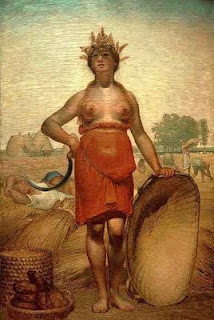
Goddess Festival Of Ceres  

Posted by Unknown in , , , , ,

Goddess Festival Of Ceres Image
Ceres is the Goddess of agriculture, and was credited with the discovery of spelt wheat, the yoking of oxen and ploughing, the sowing, protection and nourishing of the young seed, and the gift of agriculture to humankind; before this, it was said, man had subsisted on acorns, and wandered without settlement or laws. She was the first to "break open the earth", and all activities of the agricultural cycle were protected by her laws. She held the power to fertilise, multiply and fructify plant and animal seed, whose offspring were the physical incarnations of her power.

Her first plough-furrow opened the earth (Tellus' realm) to the world of men and created the first field and its boundary; she thus determined the course of settled, lawful, civilised life. She mediated between plebeian and patrician factions. She oversaw the transition of women from girlhood to womanhood, from unmarried to married life and motherhood and the growth of children from infancy. Despite her "chthonic" connections to Tellus, she was not, according to "Spaeth", an underworld deity. Rather, she maintained the boundaries between the realms of the living and the dead.

Given the appropriate rites, she would help the deceased into afterlife as an underworld shade ("Di Manes"): otherwise, the spirit of the deceased might remain among the living as a wandering, vengeful ghost.

The goddess was worshiped in many ways. There was the porca praecidanea, which involved sacrificing a fertile female pig and was necessary before a harvest. Cato indicates that sacrifices of any large food item will do, however, and suggests a pumpkin as an acceptable substitute for a pig, since it can be cut open and the seeds offered to Ceres in much the same way the entrails of the pig would be. After the offering of the "porca praecidanea", it was customary to also give the goddess a libation of wine.

The poor could offer wheat, flowers, and a libation. The expectations of afterlife for initiates in the "sacra Cereris" may have been somewhat different, as they were offered "a method of living" and of "dying with better hope".

Ceres' major festival was the Cerealia - the ludi cereales, culminating on April 19 to celebrate the growth of grain and other agricultural products. Its original form is unknown; it may have been founded during the regal era. During the Republican era, it was organised by the "plebeian aediles", and included "ludi circenses" (circus games). These opened with a horse race in the Circus Maximus, whose starting point lay just below the Aventine Temple of Ceres, Liber and Libera. In a nighttime ritual after the race, blazing torches were tied to the tails of live foxes, who were released into the Circus. The origin and purpose of this ritual are unknown; it may have been intended to cleanse the growing crops and protect them from disease and vermin, or to add warmth and vitality to their growth

Religiously, the purpose of the races and the games were to make the goddess favorably disposed toward the Roman people, so that she would give them a good harvest.

Visual depictions of Ceres were largely derived from Greek portrayals of Demeter. On two coin types, a bust of Ceres was pictured on one side, while a yoke of oxen was on the other. On other coins, she wears a crown of grain stalks called a "corona spicea", holds stalks of wheat, and is occasionally pictured with wheat and barley grains. One coin actually portrayed her wearing a modius, an instrument used to measure grain, on her head. Another pictures a bust of series on one side, and a pair of seated male figures with a wheat stalk to their side on the other. The seated men represent the official distribution of grain to the people. Annona, the goddess who personified the wheat supply, appears alongside Ceres on several coins from the imperial period. Reliefs from the Augustan period have even gone so far as to depict her as a plant growing out of the ground. In one her bust emerges from the earth, holding bunches of poppies and grain in her upraised hands while two snakes twine about her arms.

Ceres also assimilated the visual symbols of the Eleusinian Mysteries, which most Romans observed in her name. Ceres is depicted with symbols of the Mysteries, such as riding in a chariot drawn by snakes while holding a torch in her right hand.

Information collected from various sources.


Goddess Marzanna  

Posted by Unknown

Goddess Marzanna Image
"MARZANNA IS THE SLAVIC GODDESS OF WINTER. SHE WAS, IN PRE-CHRISTIAN TIMES, ASSOCIATED WITH DEATH, WINTER, AND THE HARVEST. SHE WAS WORSHIPED AS THE MOTHER AND GODDESS OF CORN AND HELD IN VERY SPECIAL REVERENCE. SHE APPEARS AS AN OLD WOMAN DRESSED IN WHITE WHO BECOMES A HAG WHEN WINTER HITS AND SLOWLY DIES OFF. SHE IS SOMETIMES ASSOCIATED WITH WITCHCRAFT AND DIVINATION.

TO INVITE AND WELCOME SPRING, AS WELL AS ARRANGE PROPER FAREWELL FOR WINTER, THE SLAVS WOULD CELEBRATE AND OLD PAGAN CUSTOM KNOWN AS THE "SINKING OF MARZANNA". EACH SPRING AN EFFIGY OF "OLD WOMAN WINTER" MADE FROM SHEAVES OF GRAIN WAS CARRIED THROUGH THE VILLAGE AND THROWN, AMID REJOICING, INTO THE NEAREST RIVER TO BANISH THE COLD OF WINTER AND WELCOME THE WARMTH OF SPRING. THIS DROWNING OF " MARZANNA "IS A REPRESENTATION OF THE SUN'S REBIRTH, HOW IT COMES BACK, IT'S RAYS STRONGER, MELTING SNOW AND BRINGING IN SPRING, LIFE. THIS RITUAL IS STILL DONE TODAY IN CERTAIN RURAL AREAS OF THE SLAVIC COUNTRIES.

Keywords: egyptians gods and goddesses  the olympian gods and goddesses  paintings of gods and goddesses  info on greek gods and goddesses  greek gods and goddesses and their powers  freemasonry satanism  freemasonry evil  freemasonry degrees  quem foi aleister crowley  freemasons book  knights templar masons  origin of freemasons  

Goddess Hina Ereere Manua  

Posted by Unknown

Goddess Hina Ereere Manua Image
HINA-'ERE'ERE-MANU'A is the Tahitian Goddess of tattooing. Her parents, Hina and Ti'i, kept her hidden away, until one day she was spied by the Gods Tu Ra'i Po and Mata Mata Arahu. They decided to seduce her, and used charcoal to draw designs on one another. Hina-'ere'ere-manu'a was fascinated by the designs and wanted one for herself. She managed to evade her mother and snuck out to get a tattoo. Her name means "Hina with the quick temper."

Keywords: roman gods and goddesses  list greek goddesses  names of roman goddesses  mythological gods and goddesses  roman messenger of the gods  egyptian god and goddesses  knights templar regalia  women in freemasonry  tarocchi aleister crowley  stone masons tools  history of the freemasonry  freemasons clothes  

Goddess Yemaya  

Posted by Unknown

Goddess Yemaya Image
YEMAYA is the Yoruban Goddess of the ocean and motherhood. She is one of the Mami Wata, water spirits known throughout western and central Africa. Worshipped primarily by women, she protects women in childbirth and is called upon to grant fertility. She is the mother of the sun and the moon, two rivers, and eleven other Gods. As Goddess of the ocean, she is also the mother of fish and is sometimes portrayed as a mermaid. When depicted as a woman, she is dressed in skirts of blue and white, symbolizing the ocean. She is a loving mother to her worshippers, but can by turns be as violent and uncontrollable as the sea.

Yemaya's name is a shortened version of YEY OMO EJA, which means "mother whose children are the fish." She is known by many names, having been brought from Africa to Brazil, Cuba, and Haiti. Depending on location, she is called IAMANJA, IAMANJE, IEMANYA, IMANJE, YEMAJA, YEMALLA, YEMANA, YEMANJA, YEMAYAH, YAMOJA, YAMOYA, YEMOJA, or YMOJA. She has also been identified with the Christian saint OUR LADY OF REGLA in syncretized religions such as Santeria. Epithets for her include:

YEMAYA ATARAMAGWA (the wealthy queen of the sea)

YEMAYA ACHABBA (stern)

YEMAYA OQQUTTE (violent)

YEMAYA OLOKUN (overpowering)

STAR OF THE SEA

OCEAN GODDESS OF THE CRESCENT MOON


Keywords: mayan gods and goddess  roman goddess of hearth  greek gods and goddesses history  celtic gods and goddess  the white goddess pagan portal  gods and goddesses symbols  magic spells and chants  do love spells work  white magic rituals  all the gods and goddesses names  wicca images  wicca candle magic  all gods and goddesses